
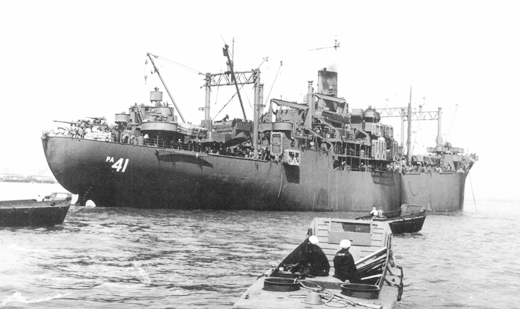
The battalion was no stranger to the APA, or "attack transport." They had staged numerous exercises aboard similar ships, practicing boarding, clambering down nets into small landing craft, and splashing ashore on the California coast. This time, though, was different. This time they would not be returning to California.
The Fourth Marine Division was about to make history as the first American unit to be transported directly from the United States to combat. Their lengthy voyage, made longer by necessary maneuvering to throw off Japanese submarines, would not be matched by any assault unit until the British invasion of the Falkland Islands nearly forty years later.
Some of the comrades they had trained with would not join them in their first foray into combat. Second Lt. Paul Rossi, the Battalion Mess Officer, was left behind, as was Corporal Henry Doxtator, who transferred to a post at Pendleton after a lengthy illness. Company clerk PFC William Davis was sick in the hospital, as were Corporal Byron Marsh, Privates First Class Billy Plemmons, William Neighbor, Joseph Maffioli, and Private Donald Ackerman. PFC Charles Horwitz, who had recently transferred from the Headquarters company, had gone AWOL on January 9. He would not return until January 24, at which time he was promptly arrested, fined $15 of his pay for the next two months, and sentenced to thirty days of "extra punitive duty." Machine gunners Peter Markovitch and Jeff Jowers did not ship out for reasons that are unclear; the muster rolls don't indicate that they were sick or in the brig, so they might have been on detached duty.
There were also some new additions as last minute assignments were handed down. PFC James McAdams joined the company just two days prior to shipping out - he had previously served with the 24th's Headquarters and Service company.
Companies B and C each had a Marine desert, and rewards of $50 were issued for their apprehension. Able Company, to my knowledge, never lost a man to desertion.
The remaining 191 Marines in the company now faced a long journey in cramped conditions.
 The officers of Able Company aboard the USS DuPage. 1st Lt. Phil Wood, 1st Lt. Roy Wood, Captain Irving Schechter, 1st Lt. Endecott Osgood, 1st Lt. David Smith.
 Officers of First Battalion, 24th Marines, on board the USS DuPage. Schechter, Phil Wood, Osgood, and Roy Wood are the four rightmost officers in the front row. David Smith is on the far left of the second row. Other notables include Major Maynard Schultz [center of second row, future battalion commander, killed on Saipan, June 16 1944], 2nd Lt. Charles Bechtol [second from left in fourth row, D Company, a friend of Phil's], 1st Lt. Joseph Swoyer [far left, top row, D Company, another friend of Phil's].
The following list is based on the combined January and February muster rolls of the First Battalion. Starting in February, each man on the roll was listed with a three digit number indicating his MOS, or Military Occupational Specialty. Also referred to as the Service Specialty Number (SSN), this indicated what job a Marine had trained for. Some, like 745 (Rifleman, carrying an M1) or 746 (Automatic Rifleman, carrying the BAR) are fairly common, while some (Kenneth Gann's MOS 800 or Sylvan McKinley's MOS 204) are still unknown to me. [Note: 204 in some databases appears as "shoe repairman," though unless McKinley was a cobbler in civilian life I doubt he would have been in a front line unit after training to re-sole boondockers]. Likewise, some Marines who later appear in photographs with the Weapons company are listed as riflemen (Czepiel, Roff, and others bear the MOS 745 for Rifleman, while mortar crew are listed as 607) and Corporal Oscar Hanson is named as a section leader, though I have no other information indicating that he has in the Weapons platoon at all. It's likely that some individuals were shifted around later in 1944, or also that their MOS does not directly correspond to the weapon they ended up carrying: each Marine was trained as a rifleman, after all, and some on this list [IE Raymond Van Dam] are listed as "521 - Basic" - meaning that they had received training in boot camp and were deemed capable of assuming any regular duty with minimal extra training. Also, it was expected that each Marine possess a basic understanding of every weapon in his outfit, which explains how Cecil Tolley (745 Rifleman) came to win his Navy Cross with a light machine gun, or how Howard Smith (745 Rifleman) won his with a BAR. Finally, the MOS system does not deliniate between the various positions on a gun crew (604 for machine gunners, 607 for mortars). In the rare event that someone has been noted as an ammunition carrier, they have been separated slightly; of particular note is John Svoboda's rating as "Ammunition NCO" - he is the Marine who was busted to PFC after being AWOL in November 1943. Nor does it specify between Squad Leaders and Assistant Squad Leaders (653). It would appear that each Sergeant led a squad backed up by a Corporal (three squads per platoon times three platoons equals nine squads; there are nine Sergeants and nine Corporals) though the two PFCs holding that MOS (McCay and Thomas) throw a bit of a monkey wrench into that assumption. So, too, does Al Perry's recollection that Bill Quinn was leading his squad into the fight, though he misidentifies Quinn's rank as a corporal, so it's possible that he was simply mistaken after many years and Quinn assumed command of the squad at a later date.
At any rate, in January, 1944, the following men were at home in Able Company and would soon face the ultimate test of combat.
COMPANY HEADQUARTERS
Captain Irving Schechter (Commanding)
1st Lt. Harry Reynolds (Executive Officer)
Gunnery Sergeant Walter Russell
Platoon Sergeant Charles Ckaminsky
Staff Sergeant Henry Fones (Clerk)
Staff Sergeant Michael Graziadei (Mess Sergeant)
Corporal Raymond Davis (Carpenter)
Corporal Kenneth Gann (MOS 800)
Assistant Cook John Yonkers
PFC Richard Brodnicki (Clerk)
PFC Robert Fleischauer
PFC Sylvan McKinley (MOS 204)
PFC Laurent Palardy
Field Music First Class Harold Fritz
Field Music First Class Lester Spangler
Field Music First Class Joseph Cardinal
Private Maurice Rosenthal
Private Raymond VanDam
RIFLE PLATOONS
1st Lt. Endecott Osgood (Rifle Platoon Leader)
1st Lt. David Smith (Rifle Platoon Leader)
1st Lt. Roy Wood (Rifle Platoon Leader)
Platoon Sergeant Jay Lohff
Platoon Sergeant Parker McBride
Platoon Sergeant Stephen Vinczi
Sergeant Warren Buchanan (Squad Leader)
Sergeant Dallas Colburn (Squad Leader)
Sergeant Lewis Gregory (Squad Leader)
Sergeant George Lowry (Squad Leader)
Sergeant Thomas Mackey (Squad Leader)
Sergeant Leo Mann (Squad Leader)
Sergeant Jack Sayers (Squad Leader)
Sergeant Carl Schott (Squad Leader)
Sergeant Maynard Worthington (Squad Leader)
Corporal William Comer (Fire Team Leader)
Corporal Albert Duryea (Fire Team Leader)
Corporal Michael Frihauf (Fire Team Leader)
Corporal Paul Geckle (Fire Team Leader)
Corporal Randall Glawe (Fire Team Leader)
Corporal Oscar Hanson (Fire Team Leader)
Corporal William Linkins (Fire Team Leader)
Corporal Joseph Leitch (Fire Team Leader)
Corporal Vernon Rigdon (Fire Team Leader)
Corporal Eugene Walsh (Fire Team Leader)
PFC Thomas McCay (Fire Team Leader)
PFC Fred Thomas (Fire Team Leader)
PFC Jesse Acklam (Rifleman)
PFC John Adelmann (Rifleman)
PFC Roy Alford (Rifleman)
PFC Lionel Bolduc (Rifleman)
PFC Kenneth Boylan (Automatic Rifleman)
PFC George Burch (Rifleman)
PFC Winston Cabe (Automatic Rifleman)
PFC John Card (Rifleman)
PFC Harold Carter (Rifleman)
PFC Joseph Chifos (Automatic Rifleman)
PFC James Chvatal (Automatic Rifleman)
PFC Edgar Collins (Automatic Rifleman)
PFC Robert Conway (Rifleman)
PFC John Corcoran (Automatic Rifleman)
PFC John Czepiel (Rifleman)
PFC Fred Davis (Rifleman)
PFC James Davis (Rifleman)
PFC James DeNicola (Rifleman)
PFC Henry Denson (Automatic Rifleman)
PFC DeWitt Dietrich (Rifleman)
PFC John Donnelly (Rifleman)
PFC Burnett Fenger (Rifleman)
PFC Charles Fischer (Automatic Rifleman)
PFC Douglas Footit (Rifleman)
PFC James Freeman (Rifleman)
PFC Sperling Garrett (Rifleman)
PFC Kenneth Gray (Automatic Rifleman)
PFC Donald Hart (Rifleman)
PFC Cecil Hendershot (Rifleman)
PFC David Henderson (Rifleman)
PFC Frank Hester (Rifleman)
PFC Edward Horan (Automatic Rifleman)
PFC Frederick Iverson (Rifleman)
PFC James Jackson (Rifleman)
PFC Ernest Jeffrey (Rifleman)
PFC Tom Johnson (Rifleman)
PFC Junior Jones (Rifleman)
PFC Lawrence Knight (Rifleman)
PFC Davis Kruse (Rifleman)
PFC Robert Larson (Automatic Rifleman)
PFC Cecil Lewis (Rifleman)
PFC Verner Lilja (Automatic Rifleman)
PFC Andrew Loban (Rifleman)
PFC Joe Locke (Rifleman)
PFC William Loutzenhiser (Rifleman)
PFC Robert Low (Rifleman)
PFC Tommy Lynchard (Rifleman)
PFC John Manson (Automatic Rifleman)
PFC George Marion (Rifleman)
PFC Glen Marshall (Rifleman)
PFC Robert Mason (Rifleman)
PFC Hubert Mauney (Rifleman)
PFC James McAdams (Rifleman)
PFC Virgil McNutt (Rifleman)
PFC Gerald Miller (Rifleman)
PFC Herschell Miller (Rifleman)
PFC Eugene Morris (Rifleman)
PFC Vern Neeson (Rifleman)
PFC Elijah Nichol (Rifleman)
PFC William Olson (Rifleman)
PFC George Pelish (Automatic Rifleman)
PFC Alva Perry (Automatic Rifleman)
PFC Robert Price (Automatic Rifleman)
PFC William Quinn (Rifleman)
PFC John Rayley (Rifleman)
PFC William Rewerts (Rifleman)
PFC Blaine Riley (Rifleman)
PFC Willard Roberts (Rifleman)
PFC Joe Roff (Rifleman)
PFC Leon Roquet (Rifleman)
PFC Lionel Salazar (Rifleman)
PFC Paul Scanlon (Rifleman)
PFC Howard Smith (Rifleman)
PFC Richard Smith (Rifleman)
PFC Edward Solak (Rifleman)
PFC Peteus Staeyert (Rifleman)
PFC Edward Stewart (Automatic Rifleman)
PFC James Stokes (Rifleman)
PFC Odis Taylor (Automatic Rifleman)
PFC Robert Tierney (Rifleman)
PFC Charles Townsend (Rifleman)
PFC Roger Trimble (Rifleman)
PFC Robert Vail (Rifleman)
PFC Philip Valley (Rifleman)
PFC Howard Voeltz (Rifleman)
PFC Robert Walter (Rifleman)
PFC Robert Walton (Rifleman)
PFC Joseph Wendte (Rifleman)
PFC Kenneth Whitehurst (Automatic Rifleman)
PFC Carl Willenborg (Rifleman)
PFC Robert Williams (Automatic Rifleman)
PFC Kenneth Wilson (Rifleman)
PFC Robert Wise (Rifleman)
PFC Henry Woods (Rifleman)
PFC Clyde Yates (Automatic Rifleman)
PFC Dalton Young (Rifleman)
PFC Leonard Yush (Rifleman)
Private Ronald Bartels (Rifleman)
Private William Ellerd (Rifleman)
Private Edwin Groote (Rifleman)
Private Wallace Holt (Rifleman)
Private James Marsh (Rifleman)
Private Herbert Mauritz (Rifleman)
Private Richard McGinnis (Rifleman)
Private Dale Owings (Rifleman)
Private Lawrence Pantlin (Rifleman)
Private Robert Sievertson (Rifleman)
Private Harold Stevens (Rifleman)
Private Cecil Tolley (Rifleman)
WEAPONS PLATOON
1st Lt. Philip Wood (Weapons Platoon Leader)
Platoon Sergeant John Yaniga (Assistant Platoon Leader)
PFC John Svoboda (Ammunition NCO/Mortars)
PFC William Imm (Runner/Mortars)
MACHINE GUN SECTION
Sergeant Frank Tucker (Section Leader)Corporal Arthur Ervin (Squad Leader)
PFC Frank Hurley (Squad Leader)
PFC Luther Diehl (Squad Leader)
PFC Peter Colombo (Gun Crew)
PFC Merle Geesaman (Gun Crew)
PFC Richard Grosch (Assistant Gunner)
PFC George Hall (Gun Crew)
PFC Amedeo Izzo (Gun Crew)
PFC Raymond Jordan (Gun Crew)
PFC Howard Kerr (Gun Crew)
PFC Lester Kincaid (Gun Crew)
PFC Norman Reber (Gun Crew)
PFC George Smith (Gunner)
PFC Charles Stafford (Gun Crew)
PFC Paul Southerland (Gun Crew)
PFC Virgil Cawood (Gun Crew)
PFC Stephen Hopkins (Ammunition Carrier)
PFC David Spohn (Ammunition Carrier)
MORTAR SECTION
Sergeant Kermit Shaw (Section Leader)Corporal George Svoboda (Squad Leader)
Corporal Wilbur Plitt (Squad Leader)
PFC John Franey (Gun Crew)
PFC Frank Gosiewski (Gun Crew)
PFC Edward Hackett (Gun Crew)
PFC Howard Haff (Gun Crew)
PFC Claude Henderson (Gun Crew)
PFC William Imm (Gun Crew)
PFC Leo Ksiekievicz (Gun Crew)
PFC Ronald Palmer (Gun Crew)
PFC Donald Peters (Gun Crew)
PFC Kenneth Shea (Gun Crew)
PFC Bartholomew Wanagaitis (Gun Crew)
PFC Edward Lykins (Ammunition Carrier)


No comments:
Post a Comment