
The real beginning might have been in 2006, when I found the first three letters, carefully typed up and pasted in my grandmother's scrapbook, surrounded by pictures of a young man in uniform.
He is smiling; he has the distinctive family smile that comes from certain last names on my mother's side. Like my uncles and their cousins, he is tall and rail thin, towering above his grinning friends on the deck of a ship, arms locked, on their way to adventure. He writes beautifully, a change from the terse, semi-literate/floridly verbose missives that I am used to from years of reading about the Civil War. Pictures on preceding pages show him in a mortarboard, in high school, on summer vacation, playing with his dog, playing with his sister, and finally sitting somberly as a child, looking at the camera with sardonic trepidation.
The real beginning might have been in December, 1941, when the young man left the comforting walls of Yale Law, wrote an short note home to his Dear Girls, and dropped off the radar for months. When next they heard from them, he had enlisted in the Marine Corps. Undaunted by the minimum weight requirement for the Corps, he ate bunches of bananas and drank gallons of water before his weigh-in, and passed. Yale and dreams of being a lawyer would have to wait.
The real beginning might have been September 20, 1920, when the young man was born.
 Regardless of where the real beginning is, the story of this young man has expanded to include a vast range of characters. Some are living, some are long dead; some are Marines, some are friends; some are family, and others became as family. Some he barely knew, some barely knew him, or only knew people that he had known; some died beside him, and a few died for him.
The young man never became an old man; the dreams of being a lawyer, of being married with four children, of finishing school and living a life never came true. He died as a Marine officer leading his men, and his last action was not to end life, but to save lives. The Corps gave him a medal. Four of his friends gave him everything.
The young man has been gone for sixty four years, yet his memory still inspires tears in those who knew him.
My own part in this story began many years ago. I have been devoted to history since a fascination with ships and archeology combined into a full-fledged obsession with the RMS Titanic. By the age of ten, I could rattle off lists of statistics and facts about the doomed liner, inserted it into every art project I could, and had even been to meet and "interview" Dr. Robert Ballard (being ten, I was far too shy to actually speak to my hero, and merely sat and listened while my father read my list of questions). The Titanic led, through a convoluted and not entirely clear passage, to the naval history of the American Civil War, which touched off the proverbial powder keg of military history. By 11, I had a large diorama of the Titanic sinking in the school library; it was soon joined by a "wreck model" of the Bismark, which I had painstakingly carved up according to the latest undersea pictures of the wreck.
I had been vaguely aware that my family must have done something in the military in the past. My father's mother referred to the Blitz in her more lucid moments; other grandparents mentioned the Second World War in the particular tones that members of that generation use when describing the watershed event of the century. There were a few references to "Uncle Ned" and "Gompy" being in the service, but details were not usually forthcoming, and I was concerned mostly with the Civil War. A chance find in a Martha's Vineyard bookstore changed all that. I was reading the latest book of Dr. Ballard's, about the ships of Iron Bottom Sound off Guadalcanal. The Battle of Savo Island was under way; Japanese ships had come out of nowhere to decimate the American and Australian ships patrolling the sound. My grandmother came and looked over my shoulder as I leafed through some pictures.
"Oh!" she said. "That looks like the Quincy!"
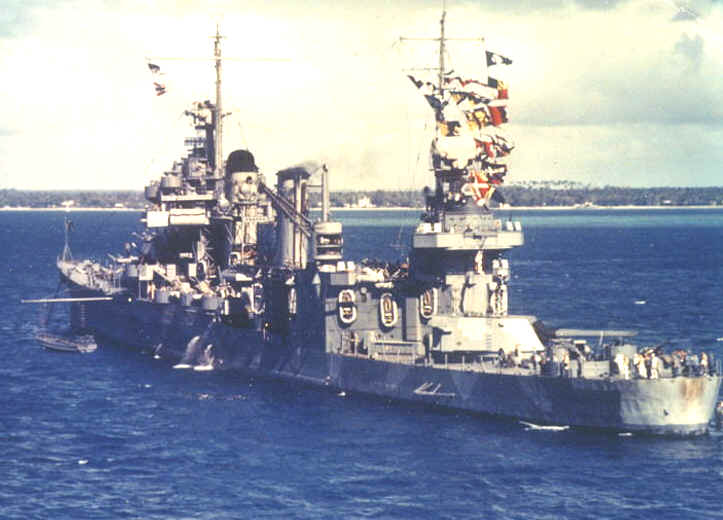
I looked at the caption. It was, indeed, the USS Quincy, CA-39.
"My uncle Ned - that's your great uncle - was an officer on the Quincy. He died in the War, you know."
I had not known. Suddenly, the picture seemed almost three dimensional. The caption said that the photograph had been taken only a week before the sinking.
I kept on reading about Savo Island. I was delighted to find Lieutenant Commander Edmund Billings mentioned in the text. A two-line description of being woken up to take command of the bridge gave me a jolt, and I pictured a dignified looking man in his forties, carrying a pipe and assuming a fatherly sort of air to the young midshipman who had woken him.
 Several pages later, the Quincy was in bad shape. The Japanese fleet had completely surprised the Allies, and shells were raining down on the American cruisers. A photograph at the top of the page showed a chilling sight: the Quincy, her burning hulk starkly illuminated by searchlights, with nowhere to hide. I read on, until I reached the last reference to Uncle Ned. I was horrified. I could clearly see the ship's bridge on fire, having taken a direct hit that killed most of the officers. Lieutenant Commander Uncle Ned stumbled from the flaming ruins - half of his face was gone. Someone heard him say, "Everything will be fine, the ship will go down fighting," before he fell lifeless to the deck.
Silently, I flipped forward to the pictures of the expedition. There lay the ruined Quincy, battle-scarred and rusting, on the floor of the sound. Most of her rear superstructure was gone. The tip of her bow was sheared off, whether during the fighting or when she hit the bottom. The pilothouse showed the scars of battle, yet illuminated in the lights of the submersible, it looked much as it did the day of the battle. I was looking at the place where a relative of mine had died; someone who was not just a figure in a historical record, but a person who my grandmother remembered and doubtless loved.
I don't remember exactly when I first heard Phil Wood's name mentioned, but it was probably my grandmother again. He was another relative, somehow connected to our family in California, and had died in the Pacific like Uncle Ned. I logged the information away, concentrating on learning about the Guadalcanal campaign, and then letting it fade entirely as I grew old enough to join a Civil War reenacting regiment. All my energy went into my new found hobby, and research books and memoirs of the 1860s gained the favored bookshelf space. I learned I had at least one Federal soldier in my background, and some cursory Web searching turned up several more possibilities. One, a private in the flashy 14th Brooklyn, shared my last name, came from the same area of Germany as my family, and even (I thought hopefully) resembled my dad, though any connection to the staunch Chasseur would doubtless be a distant one.
My grandmother, a prodigious genealogist, keeps her scrapbooks on her living room table. These massive tomes contain photographs, letters, personal recollections, and Internet research compiled into thoughtful essays. I was casually leafing through her latest effort and marveling at her thoroughness, when I saw the first letter, supplemented by a picture of three smiling men in uniform. I read through the three abbreviated missives, and was speechless. This was the Holy Grail of any history buff - letters from the front lines - and from a family member, no less. I grabbed my computer and typed them up word for word.
Two years later, we've come a long way from a clipping in a scrapbook. The entire collection of Phil's wartime correspondence - nearly fifty pages - has been collected, edited, and re-edited. Inquiries were made to veterans, and mail exchanged with a survivor of Phil's platoon. The letters were found by a producer from PBS, who re-wrote a documentary script to include them; photographs, interviews, and USMC official footage gave life to a story that already read like a movie.
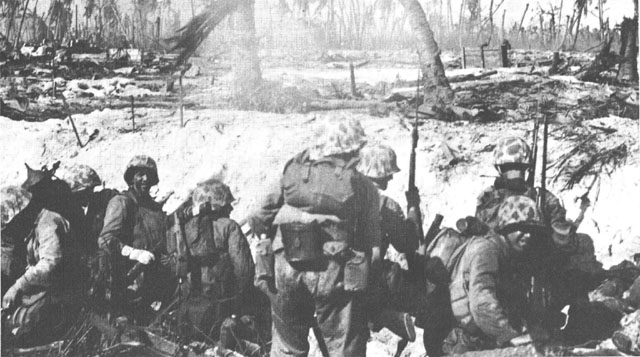 But the story of Phil Wood's time in the Marine Corps is not solely his. Each name he mentioned was an individual soldier with a life and family behind him. The veterans I wrote to, George Smith and Al Perry, were fortunate to come through the war at all - the company suffered 97% casualties from the original contingent; only 26 of those men survived (and only seven - including Al Perry - had never been hit). They earned an astonishing number of awards for their bravery, and suffered unimaginable horrors as young men simply because they believed in their country and their comrades. From their training at Parris Island, Quantico, New River, and Camp Pendleton, to combat on Roi-Namur, Saipan, Tinian, and Iwo Jima, men from all parts of the country and all walks of life showed an intense dedication to their purpose and to each other.
This blog will serve as a means of organizing information and research that I've turned up on Company A of the 24th Marines. It will change from time to time; some assumptions will be right, others wrong (and hopefully corrected) as the story takes shape. The end result may be a factual book, may be a fictionalized account based on research (a la MacKinlay Kantor's Andersonville) - or maybe this site itself will serve as a reminder of what these soldiers experienced.


1 comment:
I'm so glad you're doing this, Geoff, and I'm really looking forward to reading each entry you add. Thank you!
Post a Comment