Showing posts with label Company A. Show all posts

Wednesday, September 7, 2011

Able Company after Iwo Jima - two views

(click on image for full size)

This first shot of the company is apparently composed of the original contingent, plus a few who transferred from Company D in early 1944. The identifications, which George and I labored over many a time, were finally kindly provided by Les Best, son-in-law of company clerk William J. Davis.


Standing, left to right:
Robert Larson, Edward DuBeck, Peteus Staeyert, Leo Mann, Ronald "Blackie" Bartels, Merle Geesaman, Leo Ksiekievicz, Francis "Doc" Felicia (corpsman), Roy Wood (company commander), Jeff Jowers, Irving Schechter (Bn-3), Gene Walsh, Harold "Hal" Fritz, Dave Spohn, Jack Sayers, Oscar "Buddy" Hanson, Tom Drake, Walt Russell (both mustang lieutenants)

Kneeling:
George Marion, Al Perry, Ed Lykins, Harold Stephens, John Gibson, Robert Price, Ed Collins, Bill Davis, Jim Chvatal, Ken Gann, Willard Roberts

Sitting:
Frank "Gus" Gosiewski, Maurice "Rosey" Rosenthal, Paul Scanlon, Ken Wilson, Tom Hurley, Joe Wendte, Robert "Peepsight" Mason

Reclining:
Pete Colombo, Dom Piccolomini, Joe Peterpaul, Clifford "Joe" Devoy


There are two configurations of the second photo - these were provided by Danielle Girdano, whose father Daniel served as a machine gunner on Iwo Jima. In this first shot, some of the Marines at left are not paying attention to the camera, while others steal a drag on a cigarette.


Someone has told the Marines to tighten it up, and now everyone is paying attention to the photographer. This is the entire strength of the company after the fighting on Iwo; they had landed with 240 men.

Tuesday, September 9, 2008

Dog Company

I've finished digitizing my roster at long last - two hundred and four pages, but much easier to read than the old Microsoft Excel spreadsheet.

As mentioned previously, while going through some of the pages from First Battalion, I found some of the missing Able Company men listed with Dog Company. My presumption is that when the Marine Corps reorganized and the weapons companies disbanded, the survivors in each were assigned to the rifle or headquarters companies as needed.

Corporal Lee R. Anderson, Junior. Irving, Texas.

Corporal Anderson was wounded in action at some point in the War. He appears in two of Al Perry's pictures; one with his new rifle squad before embarking for Saipan:

Sergeant Frihauf's squad. Lee Anderson is at the far right of the front row.


He is also listed in the photograph of survivors of the Tinian banzai attack.

Until recently, a Lee R. Anderson, Junior, age 85, was listed as living in Irving, Texas.


PFC (later Sergeant) John W. Donahue, Junior.

Sergeant Donahue appears in the photograph of Tinian survivors. I don't know much else about him at present, though initial searches indicate that he was born February 28, 1921, and died July 2, 1997, in New Jersey. If this is correct, he is buried in St. Anne's Cemetery, Belmar, NJ.

There is no indication that Donahue was wounded during the war.

PFC (later Corporal) Glenn Edgar Doster. Perrysburg, OH. SN 448508.

Doster was born March 12, 1922. He deployed with Dog Company as a PFC, and was promoted to Corporal by the time of the Tinian campaign. He was awarded a Silver Star for gallantry during the July 25 banzai attack on Tinian. Doster appears in the photograph of survivors of Tinian, but was wounded at some point during his service. His listed his next of kin as his mother, Mrs. Faye Snyder, of Perrysburg OH.

Glenn Doster died February 21, 1978, in Sumter, Florida.

Master Gunnery Sergeant Thomas Eugene Drake.

Thomas Drake enlisted on February 6, 1936, in St. Louis, Missouri. Shortly after, he was transferred to the training depot at San Diego. By April, he had been assigned to Company D, First Battalion, Sixth Marines, Second Marine Brigade; in September he transferred to Company C of the same regiment. By November, he was back with D Company.

Drake started off 1937 with his company on board the USS Utah. The Utah, a World War One era battlewagon, was by this point a gunnery training vessel. It was later destroyed during the December 7, 1941 attack on Pearl Harbor.

Thomas Drake continued with his training, and on June 24, 1937, qualified as a Marksman with the 1903 Springfield rifle. The next month, he was awarded his badge for completing Basic training, as well as qualifying as a Sharpshooter with the Browning Machine Gun.

(The USMC had three different levels of proficiency with their weapons; Marksman, Sharpshooter, and Expert. These were determined towards the end of Basic, and badges were awarded for a variety of weapons. Marines had to shoot at least well enough to qualify as a Marksman before graduating from Basic. Drake's good score with a machine gun, noted on his record as "SS BMG Bar," would be consistent with his later high rank in a Weapons company.)

In August of 1937, Private Drake and Company D were embarked on the USS Chaumont, bound for Shanghai, China.

The Sixth Marines were being rushed to the Chinese city to reinforce the Fourth Marines, who were defending the European settlement during the Japanese attack on Shanghai.

Drake stayed in Shanghai until February, 1938, when his enlistment records noted that his company was back on the Chaumont. They stopped off in Guam en route to Honolulu. The following month, Company D was posted to the USS Oklahoma, off the coast of Maui. This would be the second ship that Drake served on to be sunk at Pearl Harbor; the Oklahoma and the Utah were two of three battleships that would never return to service. The Sixth spent at most a month aboard the Oklahoma, and were then redeployed to San Diego.

During this time, Drake alternated between Companies C and D of the Sixth Marines. The reasons for these changes are not apparent, Drake's service records don't show any particular merits, but nor do they show any black marks.

In July of 1938, Drake, who had evidently been practicing at the rifle range, re-qualified as an Expert rifleman; in August he shot Expert with the Browning Automatic Rifle at Camp Kearney. His prowess was rewarded with a promotion to Private First Class, and he went on furlough from October 13 to November 10.

In early 1939, PFC Drake and several others from his company were temporarily detached to attend Elementary Machine Gun School on San Clemente Island. The course lasted for thirteen days. Drake returned to San Clemente in April, 1939, aboard the USS Arizona, where he attended another riflery course. He took another furlough from mid July to mid August.

In September of 1939, Drake was promoted to Corporal.

January of 1940 saw Drake posted to the HQ company of the Sixth Marines. His record indicates that he was "obligated to serve 4 years" in the USMC Reserve; his enlistment expired on February 5, and he reenlisted effective February 6.

Drake had a busy year, in which he disappears from records for a few months. In June he moved to the General Service Unit of the Ninth Reserve District, then later he transferred to Company A of the Seventh Defense Battalion.

Between 1940 and 1943, Thomas Drake rose in rank from Corporal in the regular Corps to Master Gunnery Sergeant of the Reserve. His service with the 24th was evidently very good; he appeared in the photograph of survivors of Tinian, and was wounded while holding the rank of Second Lieutenant. Drake was of the few enlisted men in the Corps to break into the officer's caste - a "mustang."

PFC (later Corporal) William A. Peck.

Little is known about Corporal Peck, except that he was among the survivors of Tinian.

PFC (later Corporal) Joseph M. Peterpaul

Corporal Peterpaul survived through Tinian; there is no record of his being wounded in the service.

PFC (later Corporal) James H. Pritchett.

Corporal Pritchett served through Tinian and appears in the photograph of survivors. There is a Corporal James H. Pritchett listed as wounded in action; he listed his parents in Forsyth, Georgia as his next of kin.

Saturday, August 9, 2008

The 1943 Company Roster

Here are the full page scans that Jeff Padell sent over. In each case, I've tried to add the fate of each Marine. When reading, bear in mind: all but 6 of those marked with a question mark should have WIA or KIA after them. Also, the sources I have been using don't make note of where an injury occurred, multiple wounds (there are several), or those who were wounded and returned to duty (there are several more), so WIA is a broad category... but in each case, it's a young man who was physically harmed under terrible circumstances.

Names in bold were with the company when it embarked at the end of the Iwo Jima campaign.

Jeff also kindly scanned the pages for the rest of First Battalion, which I will post sometime next week.


OFFICER ROW:
Schechter, WIA Saipan, promoted to Major, Bn-3
Osgood, transferred to HQ/24 after Namur. WIA
Reynolds, WIA Namur, Saipan (twice)
Smith, WIA Saipan
Wood, KIA Saipan
Wood, WIA Saipan, promoted to Captain, CO

ROW 1
Russell, WIA Saipan, returned to company, promoted to 2nd Lt.
Ckaminsky,?
Vinczi, transferred to HQ/24 after Tinian. WIA
Yaniga, WIA Saipan
Burke, transferred to HQ/24 prior to Namur. WIA
Buchanan, WIA Saipan

ROW 2
Gregory, WIA Iwo Jima
Lowry, WIA Tinian
McBride, WIA Saipan
Tucker, KIA Saipan
Worthington, WIA Saipan, Iwo Jima
Hufnagle

ROW 3
Colburn, WIA Saipan
Comer, WIA Saipan
Doxtator, transferred to MB San Diego
Duryea, KIA Saipan
Ervin, KIA Saipan
Gann, [likely WIA Iwo Jima]

ROW 4
Geckle
Glaive
Leitch, transferred to HQ/1/24. WIA Iwo Jima
Linkins, KIA Tinian
Mann
Marsh

ROW 5
Plitt, sick / evacuated Iwo Jima
Rigdon, WIA Saipan
Sayers, WIA Saipan, transferred to HQ/1/24
Shaw, WIA Saipan, Iwo Jima
Alford, sick / evacuated Saipan
Boylan, WIA Iwo Jima

ROW 6
Card, WIA Namur
Carter, WIA Saipan
Cawood, transferred after Tinian
Chifos
Chvatal, WIA Saipan, Iwo
Collins, WIA Saipan

ROW 7
Conway, WIA Saipan
Corcoran, KIA Iwo Jima
Davis, F. DOW Saipan
Davis, J.
Davis, R. WIA Namur
Davis, R. Jr. transferred to HQ/1/24, WIA


ROW 1
Davis, WIA Saipan
De Nicola, WIA Saipan
Denson, WIA Iwo Jima
Diehl, KIA Iwo Jima
Dietrich, KIA Saipan
Donnelly, [likely WIA Iwo Jima]

ROW 2
Fenger, sick / evacuated Saipan
Fischer, WIA Iwo Jima
Fleischauer, [likely WIA Iwo Jima]
Franey, WIA Saipan
Frihauf, KIA Tinian
Garrett, KIA Saipan

ROW 3
Geesaman, WIA Saipan, transferred HQ/1/24
Gray, KIA Iwo Jima
Grosch, KIA Tinian
Hackett, WIA Saipan
Haff, WIA Tinian
Hanson, WIA Iwo Jima

ROW 4
Hart, WIA Tinian, Iwo Jima
Henderson, DOW Tinian
Horan, KIA Iwo Jima
Hurley
Imm, WIA Saipan, Iwo Jima
Izzo, WIA Tinian

ROW 5
Jeffrey, WIA Saipan
Johnson, WIA Saipan
Jordan, WIA Saipan
Jowers, transferred HQ/1/24 after Tinian
Kerr, WIA Saipan, Tinian
Kruse, KIA Saipan

ROW 6
Ksiekievicz
Larson
Lewis, KIA Namur
Lilja, WIA Saipan
Loutzenhiser, KIA Iwo Jima
Low, transferred HQ/1/24 prior to Saipan

ROW 7
Lykins
Manson, KIA Saipan
Markovitch, WIA Saipan
McAdams, WIA Iwo Jima
McKay, KIA Saipan
Nichol, ?

ROW 8
Palardy, KIA Iwo Jima
Quinn, WIA Namur, Saipan
Ragsdale, transferred to HQ prior to Namur, MIA Saipan, presumed dead
Reber, KIA Saipan
Riley, KIA Saipan
Roff, MIA Tinian

ROW 9
Roquet, WIA Namur, Iwo Jima
Shea, WIA Tinian
Smith, G. WIA Saipan
Smith, H. WIA Tinian
Southerland, DOW Namur
Spohn, WIA Saipan

ROW 10
Staeyert, [likely WIA Iwo Jima]
Stewart, WIA Iwo Jima
Svoboda, WIA Iwo Jima
Thomas, DOW Iwo Jima
Vail, KIA Saipan
Walsh, sick / evacuated Saipan, transferred HQ/1/24


ROW 1
Wanagaitis, KIA Iwo Jima
Williams, WIA Saipan (twice)
Woods, KIA Saipan
Young, WIA Namur
Yush, WIA Iwo Jima
Fritz, WIA Tinian

ROW 2
Spangler, [likely WIA Iwo Jima]
Acklam, Transferred to HQ/1/24 after Saipan, WIA
Adelmann, Transfered to HQ/1/24 after Saipan WIA
Bartels, WIA Tinian, Iwo Jima
Burch, WIA Saipan
Colombo, [likely WIA Iwo Jima]

ROW 3
Ellerd, WIA Saipan, DOW Iwo Jima
Freeman, KIA Iwo Jima
Groote, transferred to HQ/1/24 after Tinian, KIA Iwo Jima
Hendershot, DOW Iwo Jima
Henderson, WIA Namur, transferred to HQ/Marine Amphibious Command after Namur
Hester, KIA Saipan

ROW 4
Holt, WIA Saipan, Tinian
Jackson, WIA Saipan, Iwo Jima
Jones, WIA Saipan, Iwo Jima
Knight, KIA Saipan
Loban, KIA Iwo Jima
Locke, WIA Tinian, Iwo Jima

ROW 5
Lynchard, WIA Saipan, Iwo Jima
Marsh, KIA Saipan
Marshall, WIA Saipan, Iwo Jima
Mason, WIA Saipan
Mauney, WIA Iwo Jima
McKinley, [likely WIA Iwo Jima]

ROW 6
McNutt, WIA Iwo Jima [twice]
Miller, WIA Saipan
Morey, transferred MB Camp Elliott prior to Namur
Neeson, WIA Saipan
Owings, WIA Saipan
Palmer, WIA Iwo Jima

ROW 7
Pantlin, WIA Saipan
Pelish, WIA Saipan
Perry
Peters, WIA Tinian
Plemmons, sick / hospital prior to Namur
Rayley, WIA Saipan

ROW 8
Rewerts, WIA Saipan, Iwo Jima
Roberts, WIA Iwo Jima
Salazar, WIA Saipan [twice], Tinian
Solak, WIA Saipan, Iwo Jima
Stafford, WIA Saipan
Stevens, WIA Iwo Jima

ROW 9
Stokes,
Taylor, WIA Iwo Jima
Tierney, WIA Saipan
Tolley, WIA Tinian
Trimble, WIA Iwo Jima
Voeltz, sick / evacuated Saipan

ROW 10
Walter, WIA Saipan, sick / evacuated Iwo Jima
Walton
Wendte, WIA Iwo Jima
Willenborg, KIA Saipan
Wilson, WIA Saipan
Wise, WIA Saipan

Wednesday, June 4, 2008

Training for Saipan

With the big fight for Saipan looming in the next weeks, this is probably a good time to go into a little background on the training that the 24th Marines underwent to prepare for the battle.

(R&R at Camp Maui will be another topic for another time).

The 24th sailed from Namur on February 23, 1944, exactly a month after they departed from San Diego en route to Operation Flintlock. Their experiences in combat weighed heavily on many of the men, as Phil Wood describes:

Well, we left San Diego just a month ago today – and we have now started back - not all the way, but to a rest camp. Rest Camp isn’t exactly and accurate term – more like a prizefighter’s training camp, where you go to put on weight, get back in trim. We need some of that – a lot of new equipment to replace all that was lost or damaged, and a chance to relax the boys’ minds – they’ve been under a tension for a long time now. All they – we - want to do is get back to some safe spot and eat and sleep and loaf in the sun – and see some green hills and foamy cold beer, and see a buxom open-faced country lass.

Phil Wood letter, February 23 1944

The 24th returned to a newly established rest camp on Maui (appropriately, if not imaginatively, named "Camp Maui"). The tired Marines were given a chance to rest, recuperate from their experiences, and in some cases, recover in the hospital. The camp itself was scarcely an ideal living place; the official USMC Monograph for Saipan notes that "...the 4th Division's camp on Maui were incomplete in many respects. Considerable time was necessarily spent making these camps liveable. At Camp Maui, the ubiquitous red clay caused much annoyance. In dry weather, everything was covered with red dust, in wet weather, with red mud." However, from a training standpoint, the conditions were excellent. Camp Maui possessed the only 100-target rifle range in the entire PTO, and artillery crews enjoyed huge amounts of space to practice dropping high explosive rounds on target.

The 4th Marine Division website has an excellent summary of the facilities available for the Marines:

The terrain and beaches of Maui provided excellent and rugged training ground. All the Division's amphibious maneuvers for the Marianas and Iwo Jima operations were held off Maalaea Bay. Haleakala became a super obstacle course and 13-mile hikes through its crater, a challenge to those who thought they had tough leg muscles. A total of 47 training areas, many of them belonging to the Army, were available to the Division. Six areas, consisting of gulches and rough terrain, near the camp, were used for non-tactical maneuvering. On the outskirts of camp, a demolitions area, a live-grenade course, a pistol range, and 1000-inch machine-gun range were set up. Five miles east of camp, in a gulch opening into the sea, was the Division's bazooka area, and along the coast, east of camp for about ten miles, were combat firing ranges which permitted the maneuvering and firing of tanks and halftracks in coordination with the infantry. The Division's 100-target rifle range at Opana Point was also located in this area. Another area in the vicinity was used to train motor transport drivers in the movement of troops and supplies under both day and night conditions of combat.

Army facilities on Maui available to the Division, according to Fourth Division records, "consisted of a jungle training center, a village fighting course, a cave fighting course, and an infiltration course. The fortified jungle position consisted of 22 pillboxes and emplacements well concealed in bamboo groves, under the roots of banyan trees, and in thick undergrowth."

In addition to all this, there was a mortar and artillery impact area, a seacoast artillery range and an antiaircraft firing area. The Maalaea Bay area furnished an antitank moving-target range, a close-combat range, and a 20-point rifle range. The beach at Maalaea Bay was fortified with pillboxes and emplacements modeled after the Tarawa Beach. Inland were two artillery positions and maneuver areas. In the center of the island, near the Puunene Air Station, were, the Division's tank maneuver areas.


Preparations for Operation Forager began shortly after the Division arrived on Maui.

Life here is not bad at all – they call it a rest camp, and strangely enough they almost mean it. We didn’t do anything the first week except get squared away, and now we have a light training schedule – with the emphasis on athletics and recreation.

Phil Wood letter, February 27, 1944

As mentioned before, the Division underwent a reorganization at this time. John C. Chapin, then a Lieutenant leading a rifle platoon in 3/24 and now the historian for the 4th Marine Division, summarized the reorganization in his pamphlet "Breaching the Marianas: The Battle for Saipan."

The training before Saipan was based on a new Table of Reorganization for the Marine divisions. Their sized was reduced by 2,500 men to 17,465. The artillery regiments each lost one of its 75mm pack howitzer battalions, but the infantry retained its previous units. Rifle squads, however, were reorganized to total 13, using three "fire teams" of four men with each team built around a Browning automatic rifle (BAR), a 50 percent increase in the division of this valuable weapon. The number of 60mm mortars in the division table of equipment was similarly expanded, while the number of flamethrowers grew ten-fold. In addition, the tank battalions were able to replace their antiquated light tanks with mediums.

Lt. Chapin also remembered his personal experience:

(These) months were busy, hard-working ones. The replacements that arrived to fill the gaps left by Namur's casualties (in the Kwajalein battle) had to be trained in all the complexities of field work. Most of these replacements were boys fresh from boot camp, and they were ignorant of everything but the barest essentials. Week after week was filled with long marches, field combat problems, live firing, obstacle courses, street fighting, judo, calisthenics, night and day attacks and defenses, etc. There were also lectures on the errors we'd made at Namur. Added emphasis was placed on attacking fortified positions. We worked with demolition charges of dynamite, TNT, and C-2, and with flame throwers till everyone knew them forward and backward.

John C. Chapin, "Breaching the Marianas: The Battle for Saipan."


In addition to the full schedule that Lt. Chapin mentioned, the Marines were also taught a selection of phrases in Japanese - namely, "Hands Up," "Hurry Up," "Come out and we will give you food," and the like. Generally, these lessons were given immediately before the evening movie, which was always well attended.

By March, rules and restrictions were beginning to tighten up.

We missed our liberty, because we failed to pass Col. Hart’s inspection – things are very G.I. around here – I expected a relaxation on that stuff on the theory that all hands are tired, to some extent at least. But Hell no – it’s worse than it ever was. And it’s the petty stuff that I can’t stand. The one thing that makes it positive that I won’t stay in the Corps in peacetime.

That is pretty harsh punishment – it makes it 19 days with no liberty – not that 9 AM to 10 PM is much liberty time anyway, but the boys cry for all they can get, naturally.

Phil Wood letter, March 16, 1944


It’s raining again. It rains fully half the time. I fully expect Jeanne Eagles [sic] to come swinging into the tent – and it rains with a painful regularity every time we go out into the field. And that is no fun, let me tell you – hiking in wet feet – crawling on your belly in ankle deep mud – sleeping in two inches of water, and the mosquitoes.

And when we are not out on maneuvers we are being inspected by Colonels and Generals – and they are never satisfied – we had one liberty day taken away for it. And washing gear and clothes – then trying to get them dry. In fact, the maneuvers are designed to get our gear dirty so that we’ll have something to clean for the next inspection.

Phil Wood letter, March 31, 1944.

Training intensified as March became April.
We were in the field for a long time – we covered many a mile on these dogs of mine – a lot of firing. We’ve been able to get more ammo on here than we ever got back in the States. It’s been a long, tiring session, but nobody minded it too much. We knew we had to get back into condition, and there were a lot of things we had to learn – mistakes we made last time and how to correct them – new angles to suit the different types of fighting we’re going to do next time. The Marine Corps is really damned good on that angle – preparation and careful planning. We rehearsed our methods and attack formula months before we left Pendleton, though we didn’t know it at that time. It’s the kind of foresight that pays dividends.

Phil Wood letter, April 28, 1944
The 24th Marines, in their designation as a diversionary force, skipped some of the assault landing practice required of the 23rd and 25th Marines, and instead participated in boat exercises at the Maui Amphibious Training Center.

As May commenced, individual practice gave way to large unit maneuvers, practice landings, and dress rehearsals for the event itself, and everyone knew that another move was pending.

No sensational news, except that we’ve been doing a lot of work lately. Except for those pretty grim inspections, we had little to do for the first six weeks after we got here, but the last six weeks have been spent getting us back into shape – and we are in good shape now. “Don’t send any more V-Mail, only Air Mail” is all that I’m allowed to say.

Phil Wood letter, May 6, 1944


On May 17, both the 2nd and 4th Divisions launched a full-scale mock assault, replicating the tactics and objectives they would face on Saipan. This was followed on May 19 by a second assault practice which took place under a live Navy bombardment. The general staff felt that the exercises had proceeded wonderfully; however, the junior grade officers were less impressed.

To us in the lower echelons it was just the same old stuff that we'd been doing for a solid year: filing up from compartments below decks to your assigned boat station, going over the side, hurrying down the net to beat the stopwatch, into the heaving LCVP (Landing Craft, Vehicle, Personnel), and away. Then the interminable hours of circling, meanwhile getting wet, hungry and bored. The K rations (in a waxed box) tasted like sawdust; the weather got rougher and rougher. Some of the men got seasick, and all of us were soaking wet and cold.

Finally we headed back to our transport and clambered up the cargo net with a sigh of relief. The next day it was the same thing all over again, except that this time we went ashore. This, too, had an awfully familiar feeling: wading through the surf, getting your only pair of shoes and socks wringing wet, and then onto the beach where all the sand migrated inside your shoes. A series of conflicting and confusing orders flowed down through the chain of command: halt and move on, halt and move on, go here, go there.

John C. Chapin, "Breaching the Marianas: The Battle for Saipan."


The 4th Division set sail at the end of May, crowded onto their LST transports. The Marines were not informed of their target until the ships were safely away; once the name Saipan was mentioned, many must have wondered if they would ever return to the dusty red ground of Camp Maui.


Alva Perry, Robert Fleischauer, Robert Tierney, and "Tojo" - a souvenir of Namur - at Camp Maui.

Fleischauer and Tierney were both wounded on Saipan; the former passed away a few years ago while the latter is one of the surviving members of A Company.

Tojo's ultimate fate is unknown, though one hopes it was better than that of his namesake.


"3rd Squad" on Maui shortly before shipping out to Saipan.

Standing, from left:
Mike Freihauf (KIA Tinian)
Andy Loban (KIA Iwo Jima)
Robert Wynne
Robert McGinnai
Paul Scanlon
Herbert Maurite
Robert Tierney (WIA Saipan)


Seated, from left:
Joseph Wendt
George Marion
Kenneth Grey (KIA Iwo Jima)
Lee Anderson

(The previous pictures are from Al Perry's website.)

Friday, May 23, 2008

Beginning

This isn't actually the beginning, in a number of ways.

The real beginning might have been in 2006, when I found the first three letters, carefully typed up and pasted in my grandmother's scrapbook, surrounded by pictures of a young man in uniform.

He is smiling; he has the distinctive family smile that comes from certain last names on my mother's side. Like my uncles and their cousins, he is tall and rail thin, towering above his grinning friends on the deck of a ship, arms locked, on their way to adventure. He writes beautifully, a change from the terse, semi-literate/floridly verbose missives that I am used to from years of reading about the Civil War. Pictures on preceding pages show him in a mortarboard, in high school, on summer vacation, playing with his dog, playing with his sister, and finally sitting somberly as a child, looking at the camera with sardonic trepidation.

The real beginning might have been in December, 1941, when the young man left the comforting walls of Yale Law, wrote an short note home to his Dear Girls, and dropped off the radar for months. When next they heard from them, he had enlisted in the Marine Corps. Undaunted by the minimum weight requirement for the Corps, he ate bunches of bananas and drank gallons of water before his weigh-in, and passed. Yale and dreams of being a lawyer would have to wait.

The real beginning might have been September 20, 1920, when the young man was born.

Regardless of where the real beginning is, the story of this young man has expanded to include a vast range of characters. Some are living, some are long dead; some are Marines, some are friends; some are family, and others became as family. Some he barely knew, some barely knew him, or only knew people that he had known; some died beside him, and a few died for him.

The young man never became an old man; the dreams of being a lawyer, of being married with four children, of finishing school and living a life never came true. He died as a Marine officer leading his men, and his last action was not to end life, but to save lives. The Corps gave him a medal. Four of his friends gave him everything.

The young man has been gone for sixty four years, yet his memory still inspires tears in those who knew him.


My own part in this story began many years ago. I have been devoted to history since a fascination with ships and archeology combined into a full-fledged obsession with the RMS Titanic. By the age of ten, I could rattle off lists of statistics and facts about the doomed liner, inserted it into every art project I could, and had even been to meet and "interview" Dr. Robert Ballard (being ten, I was far too shy to actually speak to my hero, and merely sat and listened while my father read my list of questions). The Titanic led, through a convoluted and not entirely clear passage, to the naval history of the American Civil War, which touched off the proverbial powder keg of military history. By 11, I had a large diorama of the Titanic sinking in the school library; it was soon joined by a "wreck model" of the Bismark, which I had painstakingly carved up according to the latest undersea pictures of the wreck.

I had been vaguely aware that my family must have done something in the military in the past. My father's mother referred to the Blitz in her more lucid moments; other grandparents mentioned the Second World War in the particular tones that members of that generation use when describing the watershed event of the century. There were a few references to "Uncle Ned" and "Gompy" being in the service, but details were not usually forthcoming, and I was concerned mostly with the Civil War. A chance find in a Martha's Vineyard bookstore changed all that. I was reading the latest book of Dr. Ballard's, about the ships of Iron Bottom Sound off Guadalcanal. The Battle of Savo Island was under way; Japanese ships had come out of nowhere to decimate the American and Australian ships patrolling the sound. My grandmother came and looked over my shoulder as I leafed through some pictures.


"Oh!" she said. "That looks like the Quincy!"
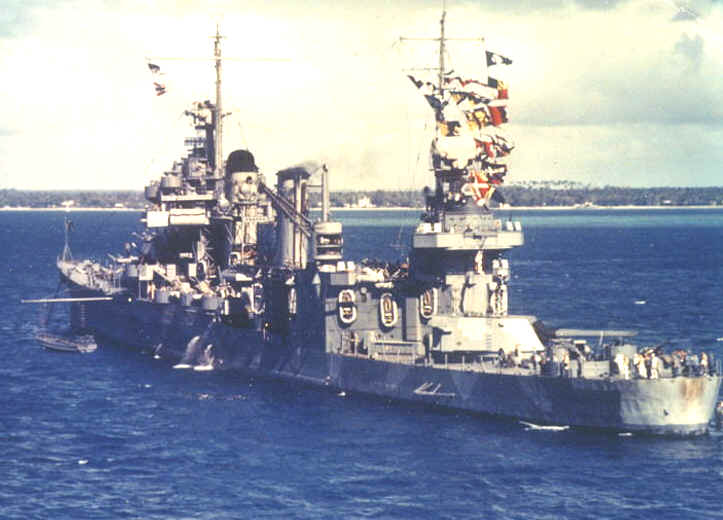
I looked at the caption. It was, indeed, the USS Quincy, CA-39.

"My uncle Ned - that's your great uncle - was an officer on the Quincy. He died in the War, you know."

I had not known. Suddenly, the picture seemed almost three dimensional. The caption said that the photograph had been taken only a week before the sinking.

I kept on reading about Savo Island. I was delighted to find Lieutenant Commander Edmund Billings mentioned in the text. A two-line description of being woken up to take command of the bridge gave me a jolt, and I pictured a dignified looking man in his forties, carrying a pipe and assuming a fatherly sort of air to the young midshipman who had woken him.

Several pages later, the Quincy was in bad shape. The Japanese fleet had completely surprised the Allies, and shells were raining down on the American cruisers. A photograph at the top of the page showed a chilling sight: the Quincy, her burning hulk starkly illuminated by searchlights, with nowhere to hide. I read on, until I reached the last reference to Uncle Ned. I was horrified. I could clearly see the ship's bridge on fire, having taken a direct hit that killed most of the officers. Lieutenant Commander Uncle Ned stumbled from the flaming ruins - half of his face was gone. Someone heard him say, "Everything will be fine, the ship will go down fighting," before he fell lifeless to the deck.

Silently, I flipped forward to the pictures of the expedition. There lay the ruined Quincy, battle-scarred and rusting, on the floor of the sound. Most of her rear superstructure was gone. The tip of her bow was sheared off, whether during the fighting or when she hit the bottom. The pilothouse showed the scars of battle, yet illuminated in the lights of the submersible, it looked much as it did the day of the battle. I was looking at the place where a relative of mine had died; someone who was not just a figure in a historical record, but a person who my grandmother remembered and doubtless loved.


I don't remember exactly when I first heard Phil Wood's name mentioned, but it was probably my grandmother again. He was another relative, somehow connected to our family in California, and had died in the Pacific like Uncle Ned. I logged the information away, concentrating on learning about the Guadalcanal campaign, and then letting it fade entirely as I grew old enough to join a Civil War reenacting regiment. All my energy went into my new found hobby, and research books and memoirs of the 1860s gained the favored bookshelf space. I learned I had at least one Federal soldier in my background, and some cursory Web searching turned up several more possibilities. One, a private in the flashy 14th Brooklyn, shared my last name, came from the same area of Germany as my family, and even (I thought hopefully) resembled my dad, though any connection to the staunch Chasseur would doubtless be a distant one.

My grandmother, a prodigious genealogist, keeps her scrapbooks on her living room table. These massive tomes contain photographs, letters, personal recollections, and Internet research compiled into thoughtful essays. I was casually leafing through her latest effort and marveling at her thoroughness, when I saw the first letter, supplemented by a picture of three smiling men in uniform. I read through the three abbreviated missives, and was speechless. This was the Holy Grail of any history buff - letters from the front lines - and from a family member, no less. I grabbed my computer and typed them up word for word.


Two years later, we've come a long way from a clipping in a scrapbook. The entire collection of Phil's wartime correspondence - nearly fifty pages - has been collected, edited, and re-edited. Inquiries were made to veterans, and mail exchanged with a survivor of Phil's platoon. The letters were found by a producer from PBS, who re-wrote a documentary script to include them; photographs, interviews, and USMC official footage gave life to a story that already read like a movie.
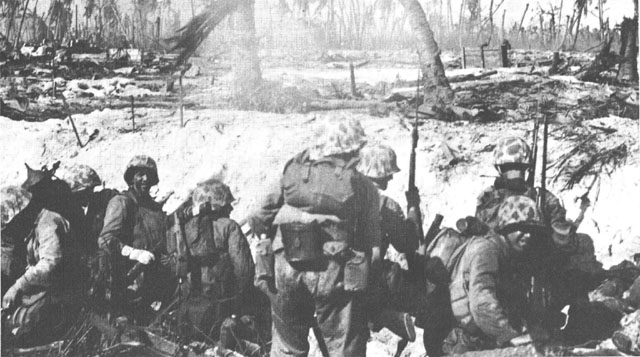
But the story of Phil Wood's time in the Marine Corps is not solely his. Each name he mentioned was an individual soldier with a life and family behind him. The veterans I wrote to, George Smith and Al Perry, were fortunate to come through the war at all - the company suffered 97% casualties from the original contingent; only 26 of those men survived (and only seven - including Al Perry - had never been hit). They earned an astonishing number of awards for their bravery, and suffered unimaginable horrors as young men simply because they believed in their country and their comrades. From their training at Parris Island, Quantico, New River, and Camp Pendleton, to combat on Roi-Namur, Saipan, Tinian, and Iwo Jima, men from all parts of the country and all walks of life showed an intense dedication to their purpose and to each other.


This blog will serve as a means of organizing information and research that I've turned up on Company A of the 24th Marines. It will change from time to time; some assumptions will be right, others wrong (and hopefully corrected) as the story takes shape. The end result may be a factual book, may be a fictionalized account based on research (a la MacKinlay Kantor's Andersonville) - or maybe this site itself will serve as a reminder of what these soldiers experienced.