Showing posts with label Navy Cross. Show all posts

Friday, July 4, 2008

Sergeant Arthur B. Ervin


One simply did not mess with Arthur Ervin.

Arthur Ervin, Junior was born April 16, 1922, in the small town of McCurtain, Oklahoma. His father died when his namesake was only six months old, leaving Arthur Junior and his brother Harley in the care of their mother.

Ervin was something of an enigmatic oddity in Company A. He traveled to Detroit, Texas and joined the Marine Corps on June 4, 1940, barely 18 years old. After completing basic training at the Recruit Depot in San Diego, Private Ervin found himself stationed in the subtropical paradise of Pearl Harbor. He served with Company B at the Marine Barracks, Pearl Harbor Navy Yard, through the end of the year.

Post-war court documents indicate that Ervin was present at Pearl Harbor on December 7, 1941. What role he might have played on the nation's most infamous day is unclear, but it seems to have cemented a burning resolve in the young man. Arthur Ervin's name appears on the muster rolls of the 2nd Raider Battalion, an "elite-within-the-elite" unit that appeared in early 1942 and was based on FDR's observations of British commando teams. Arthur Ervin served in Company C of this strictly volunteer, extremely tough and admittedly ruthless battalion. The same court documents point to service on Guadalcanal, which would almost certainly make him a veteran of Carlson's famous "Long March" - a 31-day fighting expedition behind enemy lines. The Raiders, completely cut off from outside reinforcements or supplies, harassed the Japanese army with a series of hit-and-run attacks that cost the Imperial Amy over 480 casualties, with the raiders losing just 16 dead.

Again, Ervin's record becomes blurry. After the Long Patrol (or possibly during it), he contracted elephantitis, a dramatic disease that apparently did little to curb his spirit. Indeed, while home on sick leave, he married Odena Gladys Good, whom he affectionately called "Neg."

With new developments in Marine Corps tactics, the Raider battalions were being phased out and reorganized. Ervin, returning from sick leave, somehow managed to end up in the 24th Marines, then training at Camp Pendleton, California. The 24th would benefit greatly from Ervin's combat experience, though his first mention by his platoon leader was somewhat less than complimentary:

And there won’t be enough furloughs to go around to let all the men get home again before we shove off – one squad leader has an incurable Samoan disease, a section leader is having his tonsils out, one man has chronic appendicitis, and another has bad flat feet and can’t march, another has a trick knee that was ruined on maneuvers.

- Phil Wood, letter dated November 2, 1943


[The "incurable Samoan disease" was Ervin's elephantitis - which lead to the nickname "Moo Moo," after the native term for the ailment - mumu.]

The next mention of Ervin, and indeed all further evidence, shows the true story of an exceptionally brave and selfless man.

Corporal Ervin – my ex-machine gun squad leader – up for the Navy Cross – is back from the hospital, and I nabbed him for my mortar section leader. A Hell of a good man – we work well together. And he’s squaring the section away in fine shape.

- Phil Wood letter, dated 31 March 1944


What had happened in the interval? The battle for Namur.

Corporal Ervin began to make a name for himself even before stepping off the assault boats in the early afternoon of February 1, 1944.

[P]rior to going to our boat stations we loaded up with a mouth full [of chewing tobacco]. You will understand why I told you this a little later. And as I had stated previously in combat each gun squad was assigned to a rifle platoon, my squad, along with Ervin, went in with the 1st platoon and without Phil. On the way in we passed off the starboard quarter of the new USS Washington just as she fired a full broadside. The wave she created hit us broadside and almost turned us over. Not only did we get wet, but some of us got a mouth full of water and of course the tobacco as well. For some unknown reason I decided to go with gum instead of the tobacco, Ervin stayed with the tobacco. As Phil stated, during the landing there was a tremendous explosion. But our boat was on the beach and the ramp going down when it went off. Beside being hit with concrete and steel from above a dense cloud of dust, cordite and body parts filled the boat. As I was to realize later I must have swallowed my gum at this time, Ervin did not. Some time later as we were moving up going from hole to hole for cover, Ervin being the Warrior he was decided to go straight up the road. In doing so he passed a hole with a live Jap and the Jap squeezed one off just as Ervin was even with him and the bullet traveled up his left side from his hip to his ear, not breaking the skin but leaving a burn mark here and there. Of course he killed the Jap but even as we ran to him and it was apparent he wasn't hurt hardly at all he just stood there, frozen, with this weird look on his face. Now this was one brave cat we are talking about, but there we stood in the middle of the road, four of us trying to figure out what the hell is wrong with him. Perhaps you guessed, he had swallowed his tobacco and was getting ready to throw up. And it was just about then that I discovered I didn't have gum in my mouth and realized I must have swallowed it when the block house blew.

- George Smith, personal recollection


As the other platoons of A Company landed and began their advance up the coast of the island, Ervin was a conspicuous figure.

I noticed Corporal Ervin – then my machine gun squad leader – now my mortar section leader, up ahead, waving us on. As long as he was in the action, he stayed at least 50 yards ahead of anybody else in the Company – I took a couple of the others and went up to help him. He had stumbled on a dugout containing 6 or 7 Japs, had fired at them standing on the edge – then thrown a grenade or two and come back for more....

Over our heads all Hell broke loose. My machine guns behind me started a duel with those in the blockhouse – pound after pound of lead went over, then a Jap knee mortar started pounding away, probing for our trench, but luckily never got it. During a lull in the fire fighting my runner crawled up to me, and Cpl. Ervin slipped out of the trench and went forward again. He came on a Jap machine gun nest beside the blockhouse, killed two of the men manning it, but was driven off when an officer knocked off his helmet with a round from his pistol. Ervin’s face was sprayed with bits of lead – he backed off, came back, and told us the situation – what was up there – where they were – I hopped out and went back to assign the target to my mortars – when I got there I found that a couple of the men had been wounded by the Jap knee mortars – but by the time we had set up, the forward elements of the company had moved up too close to the position to let us fire safely....

- Phil Wood letter, dated 2 April 1944

What happened next would be described in the terse wording of a Navy Cross citation.

Citation:
The President of the United States takes pleasure in presenting the Navy Cross to Arthur B. Ervin (285038), Corporal, U.S. Marine Corps, for extraordinary heroism and devotion to duty while serving with Company A, First Battalion, Twenty- Fourth Marines, FOURTH Marine Division, in action against enemy Japanese forces during the invasion of Namur Island, Kwajalein Atoll, on 1 February 1944. Advancing with his company around the eastern perimeter of the Island, corporal Ervin skillfully located and led the attack upon each hostile strong point in this zone of action. Although wounded in a single-handed assault upon an enemy heavy machine-gun nest, he returned to initiate a raid into an occupied blockhouse and, after climbing to a dangerously exposed position on its top, immediately poured rifle fire into a near-by Japanese trench fortification and exhorted his comrades to press home their attack. When painfully wounded for the second time, he gallantly refused to let anyone endanger himself by coming forward to help and, after pulling himself to safety and having his wounds dressed, retired only on the orders of his Commanding Officer. His determined fighting spirit and inspiring performance of duty throughout these bitter engagements reflect the highest credit upon Corporal Ervin and the United States Naval Service.

From his vantage point nearby, Phil Wood described the scene:

We used bazookas on the blockhouse, and finally it was silenced; [1st Lt.] Harry [Reynolds], then Cpl. Ervin ran across the open and threw hand grenades into the firing ports – I picked up Ervin’s helmet to toss it to him, but it was knocked out of my hand by a sniper’s bullet. Ervin hopped up on top of the blockhouse, and stood there silhouetted against the sky – legs spread apart, hatless, with blood on his face and his coat flung open, firing his rifle from the hip into the dugout that lay in front of Sgt. [Frank A.] Tucker and myself – he killed some, but fire kept coming at him from the dugout, so he jumped down, ran to it, and was hit just as he got in front of me. Harry and I yelled to him – he said he didn’t want any help, and pulled himself out with his right arm – he was hit in the side – and Harry had to order him back to the hospital. Ervin claimed that he could still throw grenades with his one arm.

- Phil Wood letter, dated 2 April 1944
Corporal Ervin returned to Pearl Harbor, this time in the care of Naval medical personnel. His wound was serious, though luckily did not prove life-threatening. By mid April, he was back where he wanted to be - with his fellow Marines.

In a stirring ceremony in late April, 1944, Corporal Ervin was awarded the Navy Cross by none other than Admiral Nimitz.

Ervin told me after it was over that he almost burst into tears when they told him he was getting the Navy Cross – he meant it, and for a tough, hard-bitten little guy like that to feel that way.

- Phil Wood letter, dated 28 April 1944


Phil Wood was not the only one writing home:

April 29 1944
Hello Bud
I'm sorrow that I have not written to you long before this - Received your letter last nite (somewhat delayed) So will ans. right back. How are things going with you these days - Kay, holding you down - me - I couldn't be better as you probably know by this time I'm back to duty with my old company, certainly glad to get back with the guys again my side is O.K. now and I can do allmost everything I did before, It never bothers me in the least, Guess you know that it was close, Lavada wrote me a letter just before she went to Seattle, and I'm looking for the Chief out this way any day now, By just reading your letter over I can't tell wheather or not you like the idea of waiting so long, you got a break in a way, I got a letter from Mom every 4 or 5 days Speaking of Mother Bud I did change my insurance if anyone gets it Mom will get it all, I didn't change it because of what you said in your letter, I had allready for a couple reasons of my own, one I don't want 'Neg' ever to feel obligated to me, but I know that neither you or Kay would and never did lie to me So I want to ask you something but before I ask you I want to tell you how I feel about 'Neg.' Bud she is the only one for me but things are all the way oka not at all, know what I mean? Write me and tell me if things are not that way. I don't want to plan on something and things go haywire, Let me know, Bud I have some good news for you, Do you know what the "Navy Cross" is? I was awarded the "Navy Cross" by Admiral Nimitz last Wed. I am dam proud of it and Sending it home to Mother Wish you could have been here Bud to see me get it Wonder what H.L. will think? Kay I'll send you that hula skirt this time if I can find a good one, Gotta close now will be waiting for your ans. Love to you both
Your brother
Cpl. Arthur B. Ervin

Shortly thereafter, Arthur Ervin was promoted to Sergeant. A man named Henderson was bumped up to Corporal, possibly to take the vacant squad leader position, but either way, a celebration was in order.

Ervin made Sergeant last week, and Henderson, one of my Squad leaders, made Corporal at the same time – they had been waiting for it for a long time, so I gave the Section a beer party to celebrate. Rounded up ten cases of it – hard to get, as they are limited to two bottles a night at the slop chute – even had to steal two of the cases – got grills and hamburgers to cook out there – had it all taken out to a little spot in the boondocks – ice, cigars, pogie-bait and fruit – then broke them out in marching formation at 4 PM. They didn’t know anything about it, and grumbled about it, thinking they were going on a special working party – when we got there and they saw the spread, a great shout went up, and they fell on the food and beer. It was a great success, since everyone got potted – we even had to carry two of them home when it broke up about midnight. We talked and chatted and sang old songs around the fire – and one Squad put on an impromptu floor show, which, as I remember it, was very funny.

- Phil Wood letter, May 6 1944.


Sergeant Ervin, now Section Sergeant of the weapons platoon, grew closer to Lt. Wood, and the two of them worked astonishingly well together. After the F-series reorganization, Ervin apparently followed Phil and the mortar section to the company headquarters.

The two fought side by side on Saipan until July 5, 1944, when they volunteered to lead a patrol to rescue civilians caught between the lines.

Ervin was pretty much an individualist, not given to affection, and on first impression, not a top notch NCO. But the mutual admiration and respect which grew between the two was obvious, and they were a strongly attached pair who worked together as well as any and better than most. It was Sgt. Ervin who, when Phil lay fatally wounded in an exposed position, called out “Don’t worry, Phil, I’m coming for you!” And Ervin went down to be killed at Phil’s side by the same Jap gun.

- Lt. Frederic Stott, in a letter to Anna Margretta Wood, October 7, 1944.


The remains of Sergeant Arthur Ervin, Navy Cross, Bronze Star, and Purple Heart with Gold Star, were never recovered. Despite Captain Schechter's assurances that Ervin had been buried in the 4th Marine Division cemetery, official burial documents indicate differently; the stark sentence "Disposition: Unrecoverable" is sadly confirmed by his placement on the Tablets of the Missing at the Punchbowl Cemetery in Hawaii.

George Smith concluded his memory of Corporal Ervin's experience with the tobacco with a touching moment:

When we talked about this later, and never ever when somebody else was around, Ervin would actually laugh out loud and that would be the only time. In all the time we were together I never knew him to hardly smile, let alone laugh.


Monday, June 16, 2008

Sergeant Frank Allen Tucker

Frank Tucker (347996) was born on January 13, 1914, in the tiny town of Hugo, Oklahoma.

He grew up in the town, living on
Ervin Route with his parents, two brothers, and two sisters. He attended school and took his first job in the community, as a mechanic with Babcock Brothers. Eventually, Frank met Ailene Crews, also of Hugo, and the two became close.

Frank Tucker answered his country's call on January 2, 1942. At 27, he was older than many of the other recruits at the Dallas, Texas office, but proved himself quickly during his recruit training at
MCRD San Diego. He was assigned to the Weapons platoon of Able Company in the newly formed 24th Marines, with the rank of sergeant. In the fall of 1943, Tucker departed for Hawthorne, Nevada for detached service. It is not clear where he was during this time; there are two Marine bases in Hawthorne - the Hawthorne Naval Ammunition Depot, and El Toro Marine Air Force Base, which had just been established. It is likewise unclear exactly why Tucker was detached - Phil Wood mentions having a great deal of trouble with his platoon NCOs during the period Tucker was gone - but return he did, and with a wedding ring on his finger. Ailene traveled to meet him in Hawthorne, and they were married on November 10, 1943.

Sergeant Tucker shipped out with the 24
th Marines in January, 1944. He was 29; several of his commanding officers were five years or more his junior.

A Company landed on the burning beaches of
Namur, and Frank Tucker stuck by the side of Lieutenant Wood as they moved the machine guns and mortars of the company through the blasted trees. They fought their way forward, watching their mysterious (and ferocious) Corporal Ervin take on a blockhouse singlehanded before being wounded and ordered off the line. Tucker and the others knew they had to keep moving, and it was the sergeant from Oklahoma who brought the momentum back:

Sgt. Tucker was in a hole on my left – he and [Lt. ] Harry [Reynolds] and [Lt.] Roy [Wood] and two or three from Roy’s platoon and I gave the dugout a barrage of grenades – at a range of ten yards – they were deafening – Tuck and Cpl. Robbins charged first, but were driven back by fire.Then five or six of us went over the edge of the embankment and shot everything that moved....

Phil Wood letter, April 2, 1944

As Phil Wood searched for a runner to set up his mortar section, a dozen men from the company took off running after approximately seventy five fleeing Japanese soldiers, chasing them along the beachline. They crossed a clearing and suddenly found themselves in the middle of a wild firefight, as the Japanese reached a prepared trench and turned on their pursuers. It was growing dark and the Marines were wary of launching a headlong assault against positions that might extend far beyond their knowledge. They had all heard stories of Japanese infiltrators, the dreaded night-time counterattacks, the screaming Gyokusai charge. Nobody wanted to get separated in the dark, yet a hundred yards from their front their friends were pinned. Attempts to cross the clearing were futile, and at least one man went down slammed to the ground under the Japanese fire.

Sergeant Frank Tucker was not content to let his company be cut to pieces. Darkness notwithstanding, he crawled forward until he could see the enemy trench in the moonlight. He hid behind a coconut palm and, as coolly as if he was on the firing range in San Diego, began picking off Japanese soldiers.

It didn't take long for the Japanese to notice where the fire was coming from, and they began a furious fusillade, trying to silence the lone M1 that was causing so much destruction.

Only four of us got out of that trap whole – that any did was Sgt. Tucker’s doing – seeing that they were being methodically slaughtered, he stood up and opened fire with his rifle. As each Jap arose out of the opposing trench to fire, Tucker carefully sighted in and shot him – often, as we found out later, right between the eyes. They think that he killed about 30 Japs that way – he put two enemy machine guns out of action, and gave the others a chance to pull the wounded into nearby shell holes – bullets creased his helmet, punctured his canteen, and cut off his rifle belt, but he didn’t get down until the rest of them were safely in position.

Phil Wood letter, April 2, 1944
A later count of the stacked bodies in the trench nearly confirmed Phil Wood's count: Tucker had personally accounted for thirty-eight Japanese soldiers, many of whom had been killed by a single shot to the head.

For his bravery, Sergeant Tucker received the Navy Cross:

The President of the United States takes pleasure in presenting the Navy Cross to Frank A. Tucker (347996), Sergeant, U.S. Marine Corps, for extraordinary heroism and devotion to duty while serving with Company A, First Battalion, Twenty- Fourth Marines, FOURTH Marine Division, in action against enemy Japanese forces during the invasion of Namur Island, Kwajalein Atoll, on 1 February 1944. When the Forward Echelon of his company was pinned down by the cross fire of enemy machine guns, Sergeant Tucker fearlessly exposed himself to the withering hail which continued to cause heavy casualties among his comrades and, calmly opening fire with his rifle, directed a deadly fusillade against the enemy, killing numerous Japanese. Concerned only for the safety of his comrades, he remained steadfast in his dangerously vulnerable position until the wounded were pulled into nearby shell holes and an adequate defense had been established. By his great personal valor and unwavering devotion to duty throughout this critical engagement, Sergeant Tucker saved the lives of many of his comrades and upheld the highest traditions of the United States Naval Service.

As the 24th Marines ground towards Saipan, Sergeant Tucker doubtless went about his duties as was expected of a decorated combat veteran. He was promoted to platoon sergeant before the invasion, and as second in command of the platoon, he carried an enormous responsibility along with his trusted M1.

Part of that same responsibility would be his downfall. On the night of June 15 or 16, 1944, as A Company prepared for a long night on Saipan, Tucker went to find Captain Schechter. The Captain needed information on the disposition of the weapons platoon.

That first night we dug in. I don't know how far we were from the beach, but we had made some progress. The sergeant in charge of my weapons platoon, a man named Tucker, crawled over to where I was lying to give me a report on our light machine guns and 60 millimeter mortars. The sergeant - he was from Oklahoma - had won the Navy Cross on Namur in February.

The poor guy had just started to crawl back to his platoon when he caught a full machine gun blast in his stomach. My God, was he riddled! Even today I can see him, literally cut in half.

I used to wonder what the people back home thought when they saw the name of someone they knew on a KIA list. Did they think the corpse looked like the one they'd seen in a funeral parlor back home? Because if they did, they were sadly mistaken.

After the death of Tucker, none of my men moved because our people were apt to fire if they heard even a snapping twig. Tucker had definitely been killed by Japanese fire, which meant that along with their shelling we could expect more small arms fire and probably infiltration.

- Captain Irving
Schechter, 1982, quoted in Henry Berry's "Semper Fi, Mac."

Back in the States, Ailene Crewes Tucker gave birth to Wayne Allan Tucker.

Frank Tucker returned to Hugo in June of 1948, four years and one week after his death. The Husonian Democrat ran an obituary rife with errors, among them the account that Tucker had died in a hand-to-hand fight with Japanese soldiers. One hopes that the true horror of his fate was spared his family, the majority of whom were in attendance at his funeral.

He rests in Mount Olivet Cemetery, Hugo, OK. Block 9, Row 17.

[Ailene Tucker remarried several years later, outlived her second husband, and died recently in Hugo, Oklahoma.]

Wednesday, June 11, 2008

Tools of the Trade Part 2: Crew Serviced Weapons

We had been told before we went in to expect it – that no matter how hopeless the situation, the Japs would always counter-attack, to save face and all that. They did it, but it hit our left, in B Company’s sector, before dawn with wild yelling and all the accoutrements – firecrackers, samurai waving officers who shouted commands in English – B Company was pushed back by the sheer violence of the attack, and they suffered pretty heavy casualties; but their 60mm mortars saved the day – they fired at a perilously close range, but succeeded in breaking up the charge. A damned good weapon – my favorite – if I had enough of them and enough men, I think I could pretty near win this war with them alone.

Phil Wood letter, April 2 1944
Mortars
60mm M2
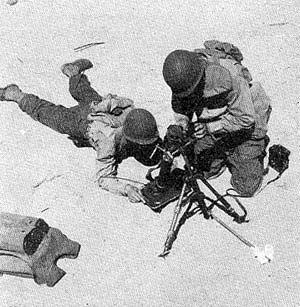
The M2 60 millimeter mortar was the basic infantry close-support weapon at the company level. Mortars have been used in warfare for many centuries, and while the design has radically changed, the basic idea behind the mortar remains the same. The barrel (or "tube") is set at a steep angle, enabling the mortar to lob shells in a high, arcing trajectory, which makes it extremely useful against fortifications. The basic design for the M2 was bought from a French engineer, Edgar Brandt, and after various tests and improvements in the late 1930s, an initial commission of 1,500 of the weapons was ordered. Like all other armaments, the outbreak of the war led to massive demand, and more than 60,000 M2s would be built - a considerable number by the Firestone Tire & Rubber Company.

Originally, the M2 was served by a crew of five. A corporal would command the team, which consisted of a gunner, an assistant gunner, and two ammunition carriers. When the Corps was reorganized, an additional ammo carrier was added to each team, bringing the total to six. The corporal, usually armed with an M1, would carry the aiming sight when on the move. The gunner carried the entire mortar, which weighed about 45 pounds, and surely seemed heavier when under fire or in the tropical heat. The assistant gunner was responsible for the aiming stakes, and each ammo bearer would carry their rounds either in the M2 ammunition vest or in a heavy bag slung over the shoulder. When the section went into action, the mortars would deploy a short distance behind the front lines (the M2 has a short range of 100 yards and a long effective range of 1000; while it was possible to launch rounds upwards of 2000 yards the smooth bore of the mortar could not guarantee accuracy). The Lieutenant or Section Sergeant in charge of the platoon would move forward to direct the fire of the section and call in adjustments as needed over a sound-power phone. The corporal relayed the instructions to the team; the gunner made the adjustments to the aim and the assistant dropped the round into the tube. Ammo carriers made sure enough rounds were available (rounds came in three types: high explosive, parachute flares, and white phosphorous, though this last was not deployed until late in the war) and if needed could provide fire support with their M1 carbines.

A good mortar crew could fire 18 aimed rounds in a minute; one that was hard-pressed could reach 30-35 rounds. Thus a company facing a serious assault (as B/24, mentioned above) would be able to count on nearly 100 rounds of high explosive per minute delivered to their immediate vicinity. While hindered somewhat in areas with thick tree cover, the 60mm mortar was a valuable addition to the company's armament.

117 60mm M2 Mortars were allocated per division.

81mm M1
The 81mm mortar was the big brother of the M2, and was the heaviest locally available weapon for a Marine battalion. Four were allocated to each battalion; originally they made up part of the weapons company, though after reorganization they were moved to headquarters.

A typical 81mm platoon consisted of four tubes split into two sections. Two lieutenants commanded the platoon, supported by a gunnery sergeant. Each section was commanded by a buck sergeant, and was further divided into squads similar to those used with the 60mm teams. Due to the weight of the mortar (136 pounds when assembled) and the ammunition (between 7 and 10 pounds, depending on type), heavy mortar platoons were issued with handcarts and a Jeep.

These big weapons had the explosive capabilities that equaled 75-105mm howitzers, depending on the round that was used, and were a force to be reckoned with on many a Pacific battlefield. In this picture, Marines from the 24th Regiment train at Camp Pendleton. WW2 Gyrene

36 81mm M1 mortars were allocated per division.


Machine Guns
M1919A4
See entry on Pvt. Cecil Ray Tolley.

302 M1919A4 .30cal MGs were allocated per division.


M1917A1

This heavy (in more ways than one) machine gun was based on a 1901 design by Browning that initially met with a lukewarm response from the Army. After providing two extraordinary demonstrations (three test fires of over 20,000 rounds without mishap - that's nearly 48 minutes worth of continuous fire), the Army adopted the improved Browning as its primary machine gun and dubbed it the Model 1917. Only 1,200 saw action in the First World War, though its handlers pronounced it effective and reliable. The remainder were put into long term storage, and unpacked again in 1941, to be augmented by a further 54,000 built by 1945.

The M1917A1 made up the primary armament of the heavy weapons companies. Originally, a battalion would be able to field 24 of these weapons, but in May 1944 their numbers were reduced to 18 and the crews were redistributed among the rifle companies. Unlike the smaller M1919A4, the M1917A1 was water-cooled, which meant a serious increase in weight. When assembled and with its water cooling jacket filled, this monster of a weapon weighed in at 93 pounds. To offset this weight, each crew was allocated two hand carts, one for towing the gun and one for the ammunition. Due to its weight, the gun was difficult to move and was used mostly in a defensive capacity, but its solid construction and cooling system meant that it was capable of extended fire and less likely to overheat than the air-cooled M1919A4. It was capable of up to 600 rounds per minute and was effective to 1100 yards.

(Top photo: Marine gunners on Cape Gloucester, from the National Archives. Bottom photo: 24th Marines training at Camp Pendleton, USMC Photo.)

162 .30 cal., M1917A1 MGs were allocated per division.

M2HB
This giant gun (65 inches from tip to tail) was most often found on aircraft, heavier tanks, ships, and landing craft. Essentially an upgraded version of Browning's .30 caliber MG, the M2 "Ma Deuce" was originally intended as an aircraft weapon or, conversely, as a mounted anti-aircraft gun. Its weight was prohibitive at first; while the aircraft version was air-cooled, ground versions needed to be water-cooled as they were prone to overheating, which brought their weight to a ponderous 121 pounds. The M2HB - HB stands for Heavy Barrel - was a design modification that allowed for an air-cooled barrel, and despite the new name, the overall weight dropped to a more manageable 84 pounds. It fired a .50 caliber slug at the rate of 450-600 per minute, though the barrel was prone to burning out unless a more conservative rate of fire was used.

Most often, the M2HB was used in either a fixed position or mounted on a vehicle. In rare instances, it would be detached to serve in its originally intended role as a light anti-armor weapon, or retrieved if a vehicle was disabled.

The two pictures here are official USMC shots, and are taken from Jeff Padell's website HQ2/24 USMC. Both show a Ma Deuce in dismounted, portable deployment. Both pictures were taken during the fight for Namur. In the first, notice the destroyed Japanese HQ in the background. In the second, the MG is set up in front of a 37mm M3 anti-tank gun (see below). These men are from a weapons company of the 24th Marines.

161 M2s were allocated per division.

Assault Weapons

2.36 Inch Anti-tank Rocket - Bazooka

The 2.36 Inch Rocket Launcher, dubbed "bazooka" by soldiers in the desert, was another product of the First World War. Initially developed as an antitank device by Dr. Robert Goddard, it was first tested just days before the 1918 armistice. Work on the project was shelved, and attention given to more conventional anti-tank rifles. However, as the 1920s became the 1930s and tank armor grew stronger, the military commissioned a top-secret project to develop the strange looking technological wonder into an effective weapon. The addition of a shaped charge projectile - one that would impact the target and eject a white hot stream of plasma to literally melt through armor plate - made the unorthodox weapon highly effective, and they were issued in secret to Army troops in North Africa in 1942.

The first Marines to receive bazookas belonged to the 1st Corps Experimental Rocket Platoon, who saw action on Bougainville in 1943. They complained that the battery circuit was too delicate, and rocket motors failed in the high humidity. A new version, the M1A1, was developed and sent over - this version featured improved electrics and rocket motors. The new bazooka showed great promise, both in its intended anti-tank capability and for demolishing fortifications.

Towards the end of the war, the M9 Bazooka was introduced. It had been adopted in 1943, but did not arrive in the Pacific until the campaign for Iwo Jima. The M9 featured still better electrics and the capability to be broken down into two sections.

Two men were required to man the bazooka, a gunner who carried the tube, and an assistant gunner, who carried ammunition and connected the electronics prior to firing. Sixteen bazookas were given to each weapons company, and three to each rifle company. No one man was assigned to carry the bazooka; instead, they were part of the Headquarters equipment and were issued as needed at the discretion of the company commander.

172 bazookas were allocated per division.

(PFC Lewis Nalder & PFC Lauren Kahn of K/3/6, 2nd Marine Division, helped repel a Japanese tank attack on Saipan, June 17 1944. They destroyed 2 tanks with their 'zook, then Kahn threw grenades into a third tank. They received the Silver Star and Navy Cross, respectively.)


Flamethrowers
Though not technically requiring a crew, the flamethrower falls squarely into the category of an assault support weapon. Primitive flamethrowers have been around since the Byzantine era (mid 600s), when hand-operated devices were installed on ships to launch streams of Greek fire into enemy sails and rigging. Other nations worked on flame technology as well (the Chinese invented their own version sometime in the 900s; flammable liquids were used in medieval siege warfare), but the idea did not seem to progress much. The first modern flamethrower is credited to the German inventor Richard Fielder in 1901. Portable flamethrowers appeared during the First World War, but their success was hindered somewhat by the dangerous nature of the technology (nobody wanted to be too close to a flamethrower if the tank was hit) and the limited range; a flamethrower could be only be operated safely from a trench, and could spew fire approximately 20 yards. Nevertheless, the tactical and (extraordinary) psychological effects of the weapon were duly noted.

The Americans began developing their own version of the flamethrower in 1940, after observing the effectiveness of new German models against the Dutch. The first models were heavy and unreliable; after considerable modifications the M1 was deployed on Guadalcanal in January 1943. This weapon used a mixture of gasoline and diesel and featured a hydrogen propellant. Fuel burned too rapidly; the operator would have to make his way to a point 10-15 yards from the enemy before having any effect. The Marines noticed also that the flame had a tendency to roll off the target, making heat and smoke but not much damage. With the revolutionary advent of napalm, the flamethrower was revised into the model M1-1, and while this was more effective the weapon was still almost more dangerous to the operator than to the enemy.

The M2, issued in the summer of 1944, featured a better ignition system and a nitrogen-based propellant. This became the standard for all campaigns thereafter. The M2 would burn through a tank in ten to twelve seconds, and had a maximum range of 33 yards. The tank was still very high-profile and heavy (70 pounds when full) and made an extremely attractive target for snipers.

The time I think about the most occurred on Saipan. I was leading my company through a wooded area. I had just climbed a small ridge when I heard a shot. I turned around and saw one of our flamethrowers lying on the ground. He was the man closest to me when the shot rang out. He had been hit in the head.

You see, it was very common for the Jap snipers to wait until we had walked by so they could pick out their target. They frequently would try to knock out the officers if possible. But above all, they wanted the special equipment men, especially the flamethrowers. My God, how they hated those men! If I had not had a flamethrower behind me, the sniper would have gone for the officer. It's as simple as that.

Captain Irving Schechter, 1982, quoted in Henry Berry's "Semper Fi, Mac."
Flamethrowers were most effective when used in combination with other tactics. A favorite method for eliminating Japanese emplacements was called "corkscrew and blowtorch." A BARman would suppress the enemy while a flamethrower crawled up close. After blasting the inside of the fortification with flame (the flamethrower's fuel did not simply burst into fire upon leaving the muzzle; instead it could shoot out several feet before igniting, which enabled the stream to literally bounce off of walls and hit targets not in the line of sight), a third Marine with a few grenades or a satchel charge would race for the entrance, using his high explosive to seal the entrance.

(Flamethrower teams on Iwo Jima, just after refilling their tanks)

No Marine relished having to carry the flamethrower (E. B. Sledge recalls trying to make himself look smaller than he was to avoid having to carry one), though many were very happy to see the results of the terrifying weapon. Flamethrowers were also mounted in specially adapted Sherman tanks, known as "Crocodiles." Marines quickly renamed them "Ronsons" or "Zippos."


Like the bazooka, flamethrowers were kept with headquarters and assigned as needed. The arrival of a brave man with a flamethrower was always welcome, as E. B. Sledge notes in With The Old Breed:

Amid our shouts of appreciation, Womack and his buddy started back to battalion headquarters to await the summons to break a deadlock somewhere else on the battlefield–or lose their lives trying. The job of flamethrower gunner was probably the least desirable of any open to a Marine infantryman. Carrying tanks with about seventy pounds of flammable jellied gasoline through enemy fire over rugged terrain in hot weather to squirt flames into the mouth of a cave or pillbox was an assignment that few survived but all carried out with magnificent courage.


243 "portable" flamethrowers were allocated to each division. The armored component would feature 24 of the specially equipped tanks.

Only one Marine was fortunate enough to have this special accessory - and I don't mean the .45 Colt on his hip:
A touching picture from the 4th Division History.

M3/M3A1 37mm Anti-Tank Gun
The light M3 anti-tank gun was developed in the late 1930s in response to the German PaK 35. Although it was quickly rendered useless against German armor - the comparatively small shells couldn't pierce Panzer armor - it found widespread acceptance in the Pacific, both in its original anti-tank role and as an anti-personnel weapon. Each regimental weapons company received twelve of the 900 pound pieces, divided into three platoons of four guns each.

The capabilities of the 37mm canister rounds were overwhelmingly apparent to men from A Company during the banzai attack on Tinian.

On our second night ashore we took the barbed wire and strung it up in front of the company. I also set up two 37 millimeter guns that could fire canisters when and if the Japs came at us.

They came all right, maybe at about half past two that morning. My company was quite undersized by this time. We were protecting the left flank of the whole bridgehead with about one hundred men.


It was at this time that my barbed wire became invaluable. God, did we pile those Japs up on it!

The Japs would yell "banzai" and my men would yell it right back at them, along with some choice obscenities. The most remarkable thing to me was that every single one of my men stayed put. I don't think one of them broke and ran. I was constantly circulating as best I could among these Marines, trying to keep a lid on things.

Then we did get a lucky break. The shells from those two 37 millimeters were devastating. I think the Japs came at us three different times and after the third charge, those 37s ran out of ammunition. I don't know if we could have stopped another charge without those shells.


Captain Irving Schechter, 1982, quoted in Henry Berry's "Semper Fi, Mac."


Five Marines serviced each gun. A sergeant served as section leader, calling out targets and
running the team. The gunner aimed and fired while the assistant gunner loaded the piece. Two assistants shuttled ammunition back and forth, as well as provided physical bracing for the gun while it was firing. Each gun had a Jeep assigned to drag it from point to point.

These Marines are fighting on Saipan. Notice the bullet holes in the shield!

Warrant Officer Ira Davidson, of the 24th Marines, would put a 37mm gun to good use on Iwo Jima. As his citation reads:

The President of the United States takes pleasure in presenting the Navy Cross to Ira Davidson (0-30070), Warrant Officer, U.S. Marine Corps (Reserve), for extraordinary heroism as Leader of a 37-mm. Gun Platoon of Weapons Company, Twenty-Fourth Marines, FOURTH Marine Division, in action against enemy Japanese forces on Iwo Jima, Volcano Islands, 21 February 1945. Observing that no supporting fire other than from infantry could be brought to bear upon six hostile pillboxes and large caliber mortars which were holding up the advance of a rifle company with intense and accurate fire, Warrant Officer Davidson volunteered to place a 37-mm. gun position to fire on the enemy point. Crossing an open strip raked by hostile antitank, small-arms, machine-gun and large caliber mortar fire, he obtained a 37-mm. gun at his platoon assembly area and personally aided in manhandling this gun across the open fire-covered airstrip for a distance of two hundred yards. After placing the gun in position, he directed accurate fire into the pillbox openings, thereby annihilating the enemy and enabling the advance to continue. Although hostile mortars had registered on his position, Warrant Officer Davidson continued to keep his gun firing and succeeded in maintaining support until his fire was masked by the advancing troops. His initiative and courageous devotion to duty in the face of intense enemy fire were in keeping with the highest traditions of the United States Naval Service.

It was later found that Davidson had landed many of his rounds directly through the firing apertures of the Japanese pillboxes.

36 guns were allocated to each division.


Next up: vehicles.

Monday, June 2, 2008

Decorations

Since the last two entries concerned Marines who won the Navy Cross, I thought I’d devote this entry to examining the different awards and who earned what during the War.

For simplicity’s sake, I’ll divide this into unit-wide awards and individual awards.

Division Awards
For participation in a particularly meritorious action, entire units would sometimes be awarded distinctive ribbons. Individuals participating in the action for which the unit was cited would be allowed to wear the decoration – hence, a replacement coming in for the battle of Iwo Jima would, at the war’s end, wear a single Presidential Unit Citation ribbon; a veteran of Saipan and Iwo Jima would wear the same ribbon with two bronze stars denoting a second award.

The 4th Marine Division, of which the 24th Regiment was a part, received the following citations during the War.


Asiatic-Pacific Campaign Medal (authorized in 1942)
This medal was awarded to individuals serving in the Pacific ETO between December 7, 1941 and March 2, 1946. Ostensibly a soldier would become eligible after serving 30 consecutive or 60 non-consecutive days, or for participating in active combat. The 4th Marine Division was also allowed four Bronze Stars on this ribbon, one for each campaign (Marshall Islands, Saipan, Tinian, and Iwo Jima).


World War Two Victory Medal (authorized in 1945)
Awarded to service personnel who served at least one day of active duty between December 7, 1941 and December 31, 1946.


Navy Unit Commendation
Awarded to any unit distinguishing itself in action with outstanding heroism; this award is one step below the Presidential Unit Citation and was awarded for service in the Marshall Islands (Operation Flintlock).

Presidential Unit Citation
The Presidential Unit Citation is the equivalent of the Navy Cross. Units receiving this decoration have exceeded the expectations of the service. The 4th Marine Division was presented with this award for efforts on Saipain / Tinian (Operation Forager) and Iwo Jima (Operation Detachment). The ribbon for this award would be decorated with two Bronze Stars to denote multiple citations.


Individual Awards
The big one is, of course, the Medal of Honor. Official citations begin with the lofty phrase “For conspicuous gallantry and intrepidity at the risk of life above and beyond the call of duty.” Only a handful of soldiers receive this award; twelve of them served in the 4th Marine Division.

- PFC Richard Beatty Anderson (E/2/23) on 1 February, 1944 – Marshall Islands. PFC Anderson dropped a grenade he was preparing to throw, and dove on it, shielding three other Marines with his body.

- Col. Justice M. Chambers (3rd Assault Bn/25) on Iwo Jima. Col. Chambers organized and personally led an eight hour attack on Japanese defensive positions on Iwo’s D-Day, helping to secure the tenuous beachhead. He was critically wounded but survived the war.

- Sgt. Darrell Samuel Cole (B/1/23) on 19 February, 1945 – Iwo Jima. With his squad trapped by a trio of Japanese pillboxes, Sgt. Cole directed his machine gun team to eliminate the nearest and most threatening. With that fortification out of action and his MG jammed, Sgt. Cole went forward alone, carrying only a pistol and a grenade. He singlehandedly destroyed the strongpoint, making numerous trips under fire for more ammunition, and was killed by an enemy grenade as he returned to his squad.

- Sgt. Ross Franklin Gray (A/1/25) on 21 February 1945 – Iwo Jima. Sgt. Franklin eliminated six Japanese fortifications singlehandedly, crawling under intense fire to hurl satchel charges into each position. He accounted for “more than 25 enemy troops and a quantity of vital ordinance gear and ammunition.”

- PFC Douglas Thomas Jacobson (3/23) on 26 February 1945 – Iwo Jima. PFC Jacboson picked up a discarded bazooka on Iwo Jima, eliminated a 20mm cannon, two MG emplacements, a “large blockhouse,” the crew of a second pillbox (which he then detonated), and seven earth-covered rifle emplacements containing ten enemy soldiers. Not content with his busy day, Jacobson volunteered to join a neighboring assault company, with whom he destroyed another pillbox, a tank, and finally assaulted a last pillbox singlehandedly. His total for the end of the day was 16 positions destroyed, one tank disabled, and nearly 75 enemy soldiers eliminated.

- Gunnery Sergeant Robert Howard McCard (A/4th Tank Bn) on 16 June, 1944 – Saipan. McCard’s tank was rendered immobile by a battery of Japanese 77mm guns. The crew continued to fire until the situation grew too dangerous, at which point Sgt. McCard ordered them to evacuate while he threw hand grenades to cover their retreat, sustaining a serious injury in the process. McCard then removed one of his tank’s machine guns and fired it at the approaching enemy, accounting for 16 Japanese before he was killed.

- Pvt. Joseph William Ozbourn (1/23) on 30 July, 1944 – Tinian. Pvt. Ozbourn, a BAR gunner, was detailed to clear out stubborn Japanese pillboxes near the end of the fighting on Tinian. He was preparing to throw a grenade when a blast from a dugout seriously wounded him and two nearby Marines. Unable to throw the grenade without injuring his friends, Ozbourn took the blast with his own body.


Five of the recipients were members of the 24th Marine Regiment.

- Private Richard Keith Sorenson (M/3/24) – 2 February 1944 – Marshall Islands. Pvt. Sorenson threw himself on a Japanese grenade, saving five other Marines. Though severely wounded, he survived the experience and joined the USMC Reserves in 1946.

- Lt. John Vincent Power (K/3/24) – 1 February 1944 – Marshall Islands. Lt. Power was badly wounded by a demolition charge, but attacked a Japanese pillbox anyway, firing his carbine with one hand. While reloading to continue the attack, he was shot a second time and killed.

- Pharmacist’s Mate Franklin Pierce (2/24) – Iwo Jima. Pierce, a Navy corpsman attached to 2nd Battalion, alternately administered first aid and covering fire for a stretcher party caught in the open. After expending the last of his ammunition, Pierce carried the last wounded men across 200 feet of open space. The next day, while attending to another wounded Marine, Pierce was wounded himself, yet declined treatment. Instead, he directed the treatment of the other Marine and again provided covering fire for other corpsmen.

- Captain Joseph Jeremiah McCarthy (2/24) – 21 February 1945 – Iwo Jima. Captain McCarthy organized an assault on Japanese positions, personally leading his men across 75 yards of open ground and assaulting two strongpoints. McCarthy personally disarmed a Japanese soldier and killed the enemy with his own weapon. He then rallied the rest of his company, pressed on, and captured a ridge near Motoyama Airfield #2.

- Lt. Col. Aquilla J. Dyess (1/24) – 2 February 1944 – Marshall Islands. The battalion commander of 1/24, Lt. Col. Dyess personally led assaults on 1 and 2 February. He was killed at the end of the battle by a Japanese machine gun.

Phil Wood was nearby:

The tanks finally came up, Col. Dyess leading the way on foot – and he organized the attack – he was fearless to the point of being foolhardy, refused to take cover – even buck privates were yelling at him to get down, but he’d only wave his Tommy gun at them and say he was a lucky Irishman.

That attack broke the back of the resistance – from then on the Japs were disorganized and fleeing. When the mortars went out of action, I went up and helped a couple of my machine gun squads root them out of their dugouts. The mortars had made a slaughterhouse of the area, and then we chased the few remaining, there couldn’t have been more than 25 or 30, up the tank trap, an 8 foot trench that ran around the island just inside the beach.

We raced after them. It was like hunting rats then – they scurried and scrambled, hid among the bodies of their own dead – there were hundreds of dead, killed by the Naval bombing the day before, lying in the trench, horribly twisted and mangled – headless, bodies laid open to the backbone, small pieces of flesh splattered on the ground, and carcasses so thick that at times we had to walk on them to get by. I remember stepping over a Samurai sword, but was too tired to even pick it up. Didn’t care. Col. Dyess was killed halfway up by a machine gun that they had set up in ambush. Fired at me, I think, but I heard the click of the bolt and hit the deck, and the shots went over me.

(Phil Wood letter, April 2, 1944)


In a 1982 interview, Captain Irving “Buck” Schechter, A/1/24, remembered Lt. Col. Dyess on the transports heading to Namur:

…this brings up the old story of the death premonition, which would sometimes come true and sometimes would not.

You see, one day when we were aboard the transports, Colonel Dyess asked to see me in private. We went over to the fantail and he put a hand on my shoulder.

"Buck," he said, "I know you're a lawyer. I also know I'm going to be killed on this operation. I want you to help me make out my will."

"Oh come on, Colonel," I answered, "I'll be glad to help on your will. My fee will be your picking up the check when we have dinner after the war back in the States. You're not going to get killed."

"Thank you, Buck, but I just feel in my bones that I am going to get killed."

And, of course, he did.

Captain Irving Schechter, 1982, quoted in Henry Berry's "Semper Fi, Mac."

The Navy Cross
The Navy Cross is the second highest decoration available to members of the Coast Guard, Navy or Marine Corps. The blue represents naval service, and the white the "purity of selflessness." The Navy Cross may only be awarded for an act committed in the presence of great danger and at great personal risk; citations reference "extraordinary heroism and devotion to duty."

The 4th Marine Division won 111 of these coveted awards; 17 in the Marshalls, 38 on Saipan, and 56 on Iwo Jima.

Members of the 24th Marines who received the Navy Cross include:

- Lt. Col. Austin Brunelli, C/O of 1/24 (Iwo Jima)

- Major Roger G. B. Broome, C/O 24th Regiment Weapons Company. June 16-July 8, 1944, Saipan.

(Major Broome's citation reads, in part: "acting on his own initiative on 5 July, he braved the heavy fire of enemy small arms to move forward into a narrow wooded defile with a 75-mm. self-propelled gun and bringing effective fire to bear on Japanese holed up in inaccessible caves, successfully attacked and enabled the infantry to advance." Whether or not this was in support of the ambushed patrol will be the subject of further research)

- PFC Frank Celentano, C/1/24. 1 February 1944, Marshall Islands. (Celentano lost a hand late on the first day of Namur as he pitched a Japanese grenade away from his comrades. He went without medical attention overnight, keeping silent so as not to give away their exposed position).

- Warrant Officer Ira Davidson, 37mm Platoon Leader, Weapons Company. 21 February 1945, Iwo Jima.

- Captain William Eddy, Jr, B/1/24. 19 February 1945, Iwo Jima.

- Captain Frank E. Garrettson, E/2/24. 1-2 February 1944, Marshall Islands. (Garrettson was wounded in the blockhouse explosion on Namur - most of 2nd Battalion's casualties were a result of the blast or falling debris - but he continued to lead his men through the rest of the battle).

- Corporal Alex Haluchak, B/1/24. 1-2 February 1944, Marshall Islands. (Wounded twice soon after landing, yet remained in the fight. Haluchak is mentioned in passing by Phil Wood, who notes that after Namur one man from "B" Company was awarded the Navy Cross).

- Captain William T. Ketcham, Jr. I/3/24. 24 February, 1945, Iwo Jima.

- Platoon Sgt. William O. Koontz, 24th Regiment Weapons Company. 7 July 1944, Saipan.

- 1st Lt. Wray C. Lewis, 3/24. 18 June 1944, Saipan.

- Sergeant James T. Mitchell, F/2/24. 15 June - 9 July, 1944, Saipan. (Sgt. Mitchell sustained two saber wounds on 4 July, though the sword wielder presumably came off worse - one hopes Sgt. Mitchell was able to bring home a souvenir of his experience!)

- Sergeant Jesse E. Murphree, G/2/24. 19 February to 15 March, 1945, Iwo Jima.

- Platoon Sgt. Michael F. Murray, Jr. C/1/24. 3 March 1945, Iwo Jima. (Posthumous)

- 2nd Lt. Stanley E. Osborn, E/2/24. July 24, 1944, Tinian.

- Private Henry T. Pound, G/2/24. 1 March 1945, Iwo Jima. (Posthumous)

- 1st Lt. Benjamin S. Preston, Jr. 3/24. 1 - 2 February, Marshall Islands. (Posthumous)

- Captain Walter J. Ridlon, F/2/24. 19 February - 16 March, 1945, Iwo Jima.

- Corporal Franklin C. Robbins, C/1/24. 19 February - 1 March, 1945, Iwo Jima.

- 1st Lt. Thomas A. Schultz, C/1/24. 15-22 June, Saipan.

- Corporal Joseph T. Sganga, F/2/24. 5 March, 1945, Iwo Jima.

- PFC Bronislaw A. Snieckus, G/2/24. 1 February, 1944, Marshall Islands.

- 1st Lt. Frederic A. Stott, Liaison Officer, 1/24. 17-18 June, Saipan. (Lt. Stott was a great friend of Phil Wood, and apparently his appellation "Fireball" was well deserved. He guided support tanks on June 17 and 18, and when his tank of June 18 was set afire by a shell, he continued to direct the attack on foot).

- PFC Louis W. Trafton, I/3/24. 4 July, 1944, Saipan.

- 1st Lt. William West, 2/24. 1 February, 1944, Marshall Islands. (Posthumous)

- PFC James R. Zarillo
, 3/24. 1 February, 1944, Marshall Islands. (Posthumous)


Finally, the following members of A Company, 24th Marines received this high honor. Each of these will eventually be the subject of their own entry.

- Corporal Arthur B. Ervin, A/1/24. 1 February, 1944, Marshall Islands.

- Captain Irving Schechter
, A/1/24. 24 - 25 July, 1944, Tinian.

- Corporal Howard Eugene Smith
, A/1/24. 2 February, 1944, Marshall Islands.

- Private Cecil Ray Tolley, A/1/24. 25 July, 1944, Tinian.

- Sgt. Frank A. Tucker, A/1/24. 1 February, 1944, Marshall Islands.


Navy Distinguished Service Medal
The Navy Distinguished Service Medal is awarded to individuals who render exceptionally meritorious service in any capacity.

The 4th Marine Division received four of these awards during the course of the War.


The Silver Star
The Silver Star is awarded for exceptional conduct against a foreign enemy of the United States - the back is inscribed "For Gallantry In Action."


Individual citations for actions meriting a Silver Star are difficult to find; this is mostly due to the number that were issued. The 4th Marine Division won 646 during the War; how many of those were awarded to the 24th is beyond my ken for the moment.

Some members of Company A received this award. It's likely there are more than these, as I find more information I'll try and update.

- Corporal Glenn Edgar Doster. 25 July, 1944, Tinian

- Corporal Wallace Morgan Holt. 25 July, 1944, Tinian.

- Private Alva R. Perry. 6 July, 1944, Saipan.

Al Perry's Silver Star citation: "For conspicuous gallantry and intrepidity while serving with Company A, First Battalion, Twenty-fourth Marines, Fourth Marine Division, in action against enemy Japanese forces on Saipan, Marianas Islands, 6 July 1944. With his company undergoing a severe enemy counterattack, Private First Class Perry fearlessly rose to his feet and walked forward firing his automatic rifle, personally accounting for twenty- seven Japanese soldiers and setting heroic examples for the balance of the platoon, who moved up behind him and broke the enemy counterattack. His initiative, inspiring gallantry and disregard for his own safety reflect the highest credit upon Private First Class Perry and the United States Naval Service."

- 1st Lt. Harry Dare Reynolds, Jr. 1 February, 1944, Marshall Islands. Lieutenant Reynolds was granted a second Silver Star on 6 July, 1944, enabling him to wear the Silver Star with Gold Star.


The Bronze Star
The Bronze Star is awarded for meritorious or heroic achievement of a slightly lesser degree than the Bronze Star. 2, 517 Bronze Stars were awarded to members of the 4th Marine Division.

Again, individual citations are difficult to come by, and again, as more information becomes available, I'll try to update the list. As of now, I only know of a few A Company men who won the Bronze Star.

- Corporal Arthur Ervin, in addition to his Navy Cross, won a Bronze Star. This was either for some action on Saipan, or in his Raider service.

- Corporal Michael Anthony Frihauf won a Bronze Star on the Marshall Islands.

- 1st Lt. Philip E. Wood, Jr. for his patrol on 5 July, 1944.


For heroic service while attached to the Twenty-Fourth Marines, Fourth Marine Division, in action against the enemy Japanese forces at Saipan, Marianas Islands, on 5 July, 1944. Volunteering to lead a patrol forward of our front lines to a cave believed to be holding Japanese soldiers and civilians, First Lieutenant Wood boldly advanced and, upon reaching the vicinity of the cave, learned that friendly natives were being held prisoner by a group of enemy soldiers. Fully aware of the danger involved in attempting a rescue, he unhesitatingly pressed forward, but was mortally wounded while performing his perilous mission. First Lieutenant Wood’s exceptional fortitude, his valiant fighting spirit and cool courage in the face of extreme danger were in keeping with the highest traditions of the United States Naval Service. He gallantly gave his life for his country.


Phil Wood was recommended for the Silver Star, but due to some piece of military bureaucracy was awarded the Bronze Star instead.


The Purple Heart
One of the most common, though undoubtedly the most tragic of military decorations, the Purple Heart is reserved for those who have been wounded or killed in action against the enemy. (The criteria for "wounded" changes with time; currently any wound requiring the attention of medical personnel is eligible for Purple Heart status). Those who are wounded more than once are awarded gold stars on their ribbon.

Few decorations are more symbolic of the suffering of warfare. The 4th Marine Division collected 611 Purple Hearts for the Marshalls, 6,262 for Saipan, and a staggering 7,863 for Iwo Jima; a total of 14, 736.

A Company sustained 97% casualties out of its original complement; by the end of the war only seven members did not sport the white and purple ribbon.

I've left the "mystery names" off this list until I know more for certain.

The Marshall Islands (Namur) 1-2 February, 1944
Corporal Arthur Ervin (WIA)
PFC Stephen Hopkins (KIA)
1 Lt. Theodore K. Johnson (KIA)
PFC Lawrence E. Knight (WIA)
Corporal Cecil G. Lewis (KIA)
1 Lt. Harry D. Reynolds (WIA)

Saipan 15 June - 9 July, 1944
PFC DeWitt L. Dietrich (KIA)
Corporal Arthur Ervin (KIA)
Cpl. Robert Fleischauer (WIA)
James William Jackson (WIA)
PFC Lawrence E. Knight (KIA)
Sgt. Arnold Ross Richardson (KIA)
PFC Lionel Perez Salazar (WIA)
PFC George A. Smith (WIA)
PFC David W. Spohn (WIA)
PFC Robert Tierney (WIA)
Sgt. Frank A. Tucker (KIA)
1st Lt. Philip E. Wood (KIA)

Tinian 24 July - 1 August 1944
PFC Richard Joseph Brodnicki (KIA)
PFC Winston McKay Cabe (WIA)
Sgt. Michael Anthony Frihauf (KIA)
Cpl. Wallace Morgan Holt (WIA)
PFC Lionel Perez Salazar (WIA)
PVT Cecil Ray Tolley (WIA)

Iwo Jima 19 February - 19 March 1945
PFC Edward H. Bookwalter (KIA)
Cpl. John Martin Corcoran (KIA)
Sgt. Luther Harold Diehl (KIA)
PFC Claude Lorton Godwin (KIA)
Sgt. Kenneth Russell Gray (KIA)
James William Jackson (WIA)
PFC Andrew Loban (KIA)
Cpl. William P. Loutzenheiser (KIA)
2nd Lt. Stephen H. Opalenik (KIA)
PFC Roland Edwin Palmer (DOW)
SSgt. James Redding (WIA)

Dates Unknown
Sgt. Thomas Eugene Drake (WIA)
PFC Allan B. Duncan (WIA)
PFC Leon H Roquet (WIA)
Capt. Irving Schechter (WIA)
PFC Howard Eugene Smith (WIA)
1st Lt. Frederic A. Stott (WIA)
Gy. Sgt. Stephen Vinczi, Jr. (WIA)
1st Lt. Roy I. Wood, Jr. (WIA)
Plt. Sgt. John Yaniga (WIA)
Cpl. Leonard Yush (WIA)