
We had been told before we went in to expect it – that no matter how hopeless the situation, the Japs would always counter-attack, to save face and all that. They did it, but it hit our left, in B Company’s sector, before dawn with wild yelling and all the accoutrements – firecrackers, samurai waving officers who shouted commands in English – B Company was pushed back by the sheer violence of the attack, and they suffered pretty heavy casualties; but their 60mm mortars saved the day – they fired at a perilously close range, but succeeded in breaking up the charge. A damned good weapon – my favorite – if I had enough of them and enough men, I think I could pretty near win this war with them alone.
Phil Wood letter, April 2 1944
Mortars
60mm M2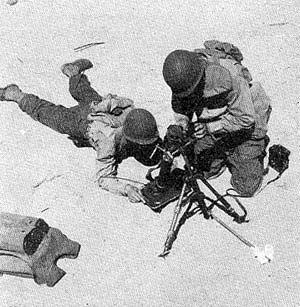 The M2 60 millimeter mortar was the basic infantry close-support weapon at the company level. Mortars have been used in warfare for many centuries, and while the design has radically changed, the basic idea behind the mortar remains the same. The barrel (or "tube") is set at a steep angle, enabling the mortar to lob shells in a high, arcing trajectory, which makes it extremely useful against fortifications. The basic design for the M2 was bought from a French engineer, Edgar Brandt, and after various tests and improvements in the late 1930s, an initial commission of 1,500 of the weapons was ordered. Like all other armaments, the outbreak of the war led to massive demand, and more than 60,000 M2s would be built - a considerable number by the Firestone Tire & Rubber Company.
Originally, the M2 was served by a crew of five. A corporal would command the team, which consisted of a gunner, an assistant gunner, and two ammunition carriers. When the Corps was reorganized, an additional ammo carrier was added to each team, bringing the total to six. The corporal, usually armed with an M1, would carry the aiming sight when on the move. The gunner carried the entire mortar, which weighed about 45 pounds, and surely seemed heavier when under fire or in the tropical heat. The assistant gunner was responsible for the aiming stakes, and each ammo bearer would carry their rounds either in the M2 ammunition vest or in a heavy bag slung over the shoulder. When the section went into action, the mortars would deploy a short distance behind the front lines (the M2 has a short range of 100 yards and a long effective range of 1000; while it was possible to launch rounds upwards of 2000 yards the smooth bore of the mortar could not guarantee accuracy). The Lieutenant or Section Sergeant in charge of the platoon would move forward to direct the fire of the section and call in adjustments as needed over a sound-power phone. The corporal relayed the instructions to the team; the gunner made the adjustments to the aim and the assistant dropped the round into the tube. Ammo carriers made sure enough rounds were available (rounds came in three types: high explosive, parachute flares, and white phosphorous, though this last was not deployed until late in the war) and if needed could provide fire support with their M1 carbines.
A good mortar crew could fire 18 aimed rounds in a minute; one that was hard-pressed could reach 30-35 rounds. Thus a company facing a serious assault (as B/24, mentioned above) would be able to count on nearly 100 rounds of high explosive per minute delivered to their immediate vicinity. While hindered somewhat in areas with thick tree cover, the 60mm mortar was a valuable addition to the company's armament.
117 60mm M2 Mortars were allocated per division.
81mm M1
 The 81mm mortar was the big brother of the M2, and was the heaviest locally available weapon for a Marine battalion. Four were allocated to each battalion; originally they made up part of the weapons company, though after reorganization they were moved to headquarters.
A typical 81mm platoon consisted of four tubes split into two sections. Two lieutenants commanded the platoon, supported by a gunnery sergeant. Each section was commanded by a buck sergeant, and was further divided into squads similar to those used with the 60mm teams. Due to the weight of the mortar (136 pounds when assembled) and the ammunition (between 7 and 10 pounds, depending on type), heavy mortar platoons were issued with handcarts and a Jeep.

These big weapons had the explosive capabilities that equaled 75-105mm howitzers, depending on the round that was used, and were a force to be reckoned with on many a Pacific battlefield. In this picture, Marines from the 24th Regiment train at Camp Pendleton. WW2 Gyrene
36 81mm M1 mortars were allocated per division.
Machine Guns
M1919A4
See entry on Pvt. Cecil Ray Tolley.
302 M1919A4 .30cal MGs were allocated per division.
M1917A1
 This heavy (in more ways than one) machine gun was based on a 1901 design by Browning that initially met with a lukewarm response from the Army. After providing two extraordinary demonstrations (three test fires of over 20,000 rounds without mishap - that's nearly 48 minutes worth of continuous fire), the Army adopted the improved Browning as its primary machine gun and dubbed it the Model 1917. Only 1,200 saw action in the First World War, though its handlers pronounced it effective and reliable. The remainder were put into long term storage, and unpacked again in 1941, to be augmented by a further 54,000 built by 1945.
The M1917A1 made up the primary armament of the heavy weapons companies. Originally, a battalion would be able to field 24 of these weapons, but in May 1944 their numbers were reduced to 18 and the crews were redistributed among the rifle companies. Unlike the smaller M1919A4, the M1917A1 was water-cooled, which meant a serious increase in weight. When assembled and with its water cooling jacket filled, this monster of a weapon weighed in at 93 pounds. To offset this weight, each crew was allocated two hand carts, one for towing the gun and one for the ammunition. Due to its weight, the gun was difficult to move and was used mostly in a defensive capacity, but its solid construction and cooling system meant that it was capable of extended fire and less likely to overheat than the air-cooled M1919A4. It was capable of up to 600 rounds per minute and was effective to 1100 yards.
(Top photo: Marine gunners on Cape Gloucester, from the National Archives. Bottom photo: 24th Marines training at Camp Pendleton, USMC Photo.)
162 .30 cal., M1917A1 MGs were allocated per division.
M2HB
This giant gun (65 inches from tip to tail) was most often found on aircraft, heavier tanks, ships, and landing craft. Essentially an upgraded version of Browning's .30 caliber MG, the M2 "Ma Deuce" was originally intended as an aircraft weapon or, conversely, as a mounted anti-aircraft gun. Its weight was prohibitive at first; while the aircraft version was air-cooled, ground versions needed to be water-cooled as they were prone to overheating, which brought their weight to a ponderous 121 pounds. The M2HB - HB stands for Heavy Barrel - was a design modification that allowed for an air-cooled barrel, and despite the new name, the overall weight dropped to a more manageable 84 pounds. It fired a .50 caliber slug at the rate of 450-600 per minute, though the barrel was prone to burning out unless a more conservative rate of fire was used.
 Most often, the M2HB was used in either a fixed position or mounted on a vehicle. In rare instances, it would be detached to serve in its originally intended role as a light anti-armor weapon, or retrieved if a vehicle was disabled.
The two pictures here are official USMC shots, and are taken from Jeff Padell's website HQ2/24 USMC. Both show a Ma Deuce in dismounted, portable deployment. Both pictures were taken during the fight for Namur. In the first, notice the destroyed Japanese HQ in the background. In the second, the MG is set up in front of a 37mm M3 anti-tank gun (see below). These men are from a weapons company of the 24th Marines.
161 M2s were allocated per division.
See entry on Pvt. Cecil Ray Tolley.
302 M1919A4 .30cal MGs were allocated per division.
M1917A1
This heavy (in more ways than one) machine gun was based on a 1901 design by Browning that initially met with a lukewarm response from the Army. After providing two extraordinary demonstrations (three test fires of over 20,000 rounds without mishap - that's nearly 48 minutes worth of continuous fire), the Army adopted the improved Browning as its primary machine gun and dubbed it the Model 1917. Only 1,200 saw action in the First World War, though its handlers pronounced it effective and reliable. The remainder were put into long term storage, and unpacked again in 1941, to be augmented by a further 54,000 built by 1945.The M1917A1 made up the primary armament of the heavy weapons companies. Originally, a
battalion would be able to field 24 of these weapons, but in May 1944 their numbers were reduced to 18 and the crews were redistributed among the rifle companies. Unlike the smaller M1919A4, the M1917A1 was water-cooled, which meant a serious increase in weight. When assembled and with its water cooling jacket filled, this monster of a weapon weighed in at 93 pounds. To offset this weight, each crew was allocated two hand carts, one for towing the gun and one for the ammunition. Due to its weight, the gun was difficult to move and was used mostly in a defensive capacity, but its solid construction and cooling system meant that it was capable of extended fire and less likely to overheat than the air-cooled M1919A4. It was capable of up to 600 rounds per minute and was effective to 1100 yards.(Top photo: Marine gunners on Cape Gloucester, from the National Archives. Bottom photo: 24th Marines training at Camp Pendleton, USMC Photo.)
162 .30 cal., M1917A1 MGs were allocated per division.
M2HB

This giant gun (65 inches from tip to tail) was most often found on aircraft, heavier tanks, ships, and landing craft. Essentially an upgraded version of Browning's .30 caliber MG, the M2 "Ma Deuce" was originally intended as an aircraft weapon or, conversely, as a mounted anti-aircraft gun. Its weight was prohibitive at first; while the aircraft version was air-cooled, ground versions needed to be water-cooled as they were prone to overheating, which brought their weight to a ponderous 121 pounds. The M2HB - HB stands for Heavy Barrel - was a design modification that allowed for an air-cooled barrel, and despite the new name, the overall weight dropped to a more manageable 84 pounds. It fired a .50 caliber slug at the rate of 450-600 per minute, though the barrel was prone to burning out unless a more conservative rate of fire was used.
 Most often, the M2HB was used in either a fixed position or mounted on a vehicle. In rare instances, it would be detached to serve in its originally intended role as a light anti-armor weapon, or retrieved if a vehicle was disabled.
The two pictures here are official USMC shots, and are taken from Jeff Padell's website HQ2/24 USMC. Both show a Ma Deuce in dismounted, portable deployment. Both pictures were taken during the fight for Namur. In the first, notice the destroyed Japanese HQ in the background. In the second, the MG is set up in front of a 37mm M3 anti-tank gun (see below). These men are from a weapons company of the 24th Marines.
161 M2s were allocated per division.
Assault Weapons
2.36 Inch Anti-tank Rocket - Bazooka
 The 2.36 Inch Rocket Launcher, dubbed "bazooka" by soldiers in the desert, was another product of the First World War. Initially developed as an antitank device by Dr. Robert Goddard, it was first tested just days before the 1918 armistice. Work on the project was shelved, and attention given to more conventional anti-tank rifles. However, as the 1920s became the 1930s and tank armor grew stronger, the military commissioned a top-secret project to develop the strange looking technological wonder into an effective weapon. The addition of a shaped charge projectile - one that would impact the target and eject a white hot stream of plasma to literally melt through armor plate - made the unorthodox weapon highly effective, and they were issued in secret to Army troops in North Africa in 1942.
The first Marines to receive bazookas belonged to the 1st Corps Experimental Rocket Platoon, who saw action on Bougainville in 1943. They complained that the battery circuit was too delicate, and rocket motors failed in the high humidity. A new version, the M1A1, was developed and sent over - this version featured improved electrics and rocket motors. The new bazooka showed great promise, both in its intended anti-tank capability and for demolishing fortifications.
Towards the end of the war, the M9 Bazooka was introduced. It had been adopted in 1943, but did not arrive in the Pacific until the campaign for Iwo Jima. The M9 featured still better electrics and the capability to be broken down into two sections.
 Two men were required to man the bazooka, a gunner who carried the tube, and an assistant gunner, who carried ammunition and connected the electronics prior to firing. Sixteen bazookas were given to each weapons company, and three to each rifle company. No one man was assigned to carry the bazooka; instead, they were part of the Headquarters equipment and were issued as needed at the discretion of the company commander.
172 bazookas were allocated per division.
(PFC Lewis Nalder & PFC Lauren Kahn of K/3/6, 2nd Marine Division, helped repel a Japanese tank attack on Saipan, June 17 1944. They destroyed 2 tanks with their 'zook, then Kahn threw grenades into a third tank. They received the Silver Star and Navy Cross, respectively.)
Flamethrowers
Though not technically requiring a crew, the flamethrower falls squarely into the category of an assault support weapon. Primitive flamethrowers have been around since the Byzantine era (mid 600s), when hand-operated devices were installed on ships to launch streams of Greek fire into enemy sails and rigging. Other nations worked on flame technology as well (the Chinese invented their own version sometime in the 900s; flammable liquids were used in medieval siege warfare), but the idea did not seem to progress much. The first modern flamethrower is credited to the German inventor Richard Fielder in 1901. Portable flamethrowers appeared during the First World War, but their success was hindered somewhat by the dangerous nature of the technology (nobody wanted to be too close to a flamethrower if the tank was hit) and the limited range; a flamethrower could be only be operated safely from a trench, and could spew fire approximately 20 yards. Nevertheless, the tactical and (extraordinary) psychological effects of the weapon were duly noted.
The Americans began developing their own version of the flamethrower in 1940, after observing the effectiveness of new German models against the Dutch. The first models were heavy and unreliable; after considerable modifications the M1 was deployed on Guadalcanal in January 1943. This weapon used a mixture of gasoline and diesel and featured a hydrogen propellant. Fuel burned too rapidly; the operator would have to make his way to a point 10-15 yards from the enemy before having any effect. The Marines noticed also that the flame had a tendency to roll off the target, making heat and smoke but not much damage. With the revolutionary advent of napalm, the flamethrower was revised into the model M1-1, and while this was more effective the weapon was still almost more dangerous to the operator than to the enemy.
 The M2, issued in the summer of 1944, featured a better ignition system and a nitrogen-based propellant. This became the standard for all campaigns thereafter. The M2 would burn through a tank in ten to twelve seconds, and had a maximum range of 33 yards. The tank was still very high-profile and heavy (70 pounds when full) and made an extremely attractive target for snipers.
 (Flamethrower teams on Iwo Jima, just after refilling their tanks)
No Marine relished having to carry the flamethrower (E. B. Sledge recalls trying to make himself look smaller than he was to avoid having to carry one), though many were very happy to see the results of the terrifying weapon. Flamethrowers were also mounted in specially adapted Sherman tanks, known as "Crocodiles." Marines quickly renamed them "Ronsons" or "Zippos."

Like the bazooka, flamethrowers were kept with headquarters and assigned as needed. The arrival of a brave man with a flamethrower was always welcome, as E. B. Sledge notes in With The Old Breed:
243 "portable" flamethrowers were allocated to each division. The armored component would feature 24 of the specially equipped tanks.
Only one Marine was fortunate enough to have this special accessory - and I don't mean the .45 Colt on his hip:
 A touching picture from the 4th Division History.
M3/M3A1 37mm Anti-Tank Gun
 The light M3 anti-tank gun was developed in the late 1930s in response to the German PaK 35. Although it was quickly rendered useless against German armor - the comparatively small shells couldn't pierce Panzer armor - it found widespread acceptance in the Pacific, both in its original anti-tank role and as an anti-personnel weapon. Each regimental weapons company received twelve of the 900 pound pieces, divided into three platoons of four guns each.
The capabilities of the 37mm canister rounds were overwhelmingly apparent to men from A Company during the banzai attack on Tinian.
Five Marines serviced each gun. A sergeant served as section leader, calling out targets and running the team. The gunner aimed and fired while the assistant gunner loaded the piece. Two assistants shuttled ammunition back and forth, as well as provided physical bracing for the gun while it was firing. Each gun had a Jeep assigned to drag it from point to point.
These Marines are fighting on Saipan. Notice the bullet holes in the shield!
Warrant Officer Ira Davidson, of the 24th Marines, would put a 37mm gun to good use on Iwo Jima. As his citation reads:
The President of the United States takes pleasure in presenting the Navy Cross to Ira Davidson (0-30070), Warrant Officer, U.S. Marine Corps (Reserve), for extraordinary heroism as Leader of a 37-mm. Gun Platoon of Weapons Company, Twenty-Fourth Marines, FOURTH Marine Division, in action against enemy Japanese forces on Iwo Jima, Volcano Islands, 21 February 1945. Observing that no supporting fire other than from infantry could be brought to bear upon six hostile pillboxes and large caliber mortars which were holding up the advance of a rifle company with intense and accurate fire, Warrant Officer Davidson volunteered to place a 37-mm. gun position to fire on the enemy point. Crossing an open strip raked by hostile antitank, small-arms, machine-gun and large caliber mortar fire, he obtained a 37-mm. gun at his platoon assembly area and personally aided in manhandling this gun across the open fire-covered airstrip for a distance of two hundred yards. After placing the gun in position, he directed accurate fire into the pillbox openings, thereby annihilating the enemy and enabling the advance to continue. Although hostile mortars had registered on his position, Warrant Officer Davidson continued to keep his gun firing and succeeded in maintaining support until his fire was masked by the advancing troops. His initiative and courageous devotion to duty in the face of intense enemy fire were in keeping with the highest traditions of the United States Naval Service.
It was later found that Davidson had landed many of his rounds directly through the firing apertures of the Japanese pillboxes.
36 guns were allocated to each division.
Next up: vehicles.
2.36 Inch Anti-tank Rocket - Bazooka
The 2.36 Inch Rocket Launcher, dubbed "bazooka" by soldiers in the desert, was another product of the First World War. Initially developed as an antitank device by Dr. Robert Goddard, it was first tested just days before the 1918 armistice. Work on the project was shelved, and attention given to more conventional anti-tank rifles. However, as the 1920s became the 1930s and tank armor grew stronger, the military commissioned a top-secret project to develop the strange looking technological wonder into an effective weapon. The addition of a shaped charge projectile - one that would impact the target and eject a white hot stream of plasma to literally melt through armor plate - made the unorthodox weapon highly effective, and they were issued in secret to Army troops in North Africa in 1942.The first Marines to receive bazookas belonged to the 1st Corps Experimental Rocket Platoon, who saw action on Bougainville in 1943. They complained that the battery circuit was too delicate, and rocket motors failed in the high humidity. A new version, the M1A1, was developed and sent over - this version featured improved electrics and rocket motors. The new bazooka showed great promise, both in its intended anti-tank capability and for demolishing fortifications.
Towards the end of the war, the M9 Bazooka was introduced. It had been adopted in 1943, but did not arrive in the Pacific until the campaign for Iwo Jima. The M9 featured still better electrics and the capability to be broken down into two sections.
Two men were required to man the bazooka, a gunner who carried the tube, and an assistant gunner, who carried ammunition and connected the electronics prior to firing. Sixteen bazookas were given to each weapons company, and three to each rifle company. No one man was assigned to carry the bazooka; instead, they were part of the Headquarters equipment and were issued as needed at the discretion of the company commander.172 bazookas were allocated per division.
(PFC Lewis Nalder & PFC Lauren Kahn of K/3/6, 2nd Marine Division, helped repel a Japanese tank attack on Saipan, June 17 1944. They destroyed 2 tanks with their 'zook, then Kahn threw grenades into a third tank. They received the Silver Star and Navy Cross, respectively.)
Flamethrowers
Though not technically requiring a crew, the flamethrower falls squarely into the category of an assault support weapon. Primitive flamethrowers have been around since the Byzantine era (mid 600s), when hand-operated devices were installed on ships to launch streams of Greek fire into enemy sails and rigging. Other nations worked on flame technology as well (the Chinese invented their own version sometime in the 900s; flammable liquids were used in medieval siege warfare), but the idea did not seem to progress much. The first modern flamethrower is credited to the German inventor Richard Fielder in 1901. Portable flamethrowers appeared during the First World War, but their success was hindered somewhat by the dangerous nature of the technology (nobody wanted to be too close to a flamethrower if the tank was hit) and the limited range; a flamethrower could be only be operated safely from a trench, and could spew fire approximately 20 yards. Nevertheless, the tactical and (extraordinary) psychological effects of the weapon were duly noted.
The Americans began developing their own version of the flamethrower in 1940, after observing the effectiveness of new German models against the Dutch. The first models were heavy and unreliable; after considerable modifications the M1 was deployed on Guadalcanal in January 1943. This weapon used a mixture of gasoline and diesel and featured a hydrogen propellant. Fuel burned too rapidly; the operator would have to make his way to a point 10-15 yards from the enemy before having any effect. The Marines noticed also that the flame had a tendency to roll off the target, making heat and smoke but not much damage. With the revolutionary advent of napalm, the flamethrower was revised into the model M1-1, and while this was more effective the weapon was still almost more dangerous to the operator than to the enemy.
The M2, issued in the summer of 1944, featured a better ignition system and a nitrogen-based propellant. This became the standard for all campaigns thereafter. The M2 would burn through a tank in ten to twelve seconds, and had a maximum range of 33 yards. The tank was still very high-profile and heavy (70 pounds when full) and made an extremely attractive target for snipers.Flamethrowers were most effective when used in combination with other tactics. A favorite method for eliminating Japanese emplacements was called "corkscrew and blowtorch." A BARman would suppress the enemy while a flamethrower crawled up close. After blasting the inside of the fortification with flame (the flamethrower's fuel did not simply burst into fire upon leaving the muzzle; instead it could shoot out several feet before igniting, which enabled the stream to literally bounce off of walls and hit targets not in the line of sight), a third Marine with a few grenades or a satchel charge would race for the entrance, using his high explosive to seal the entrance.
The time I think about the most occurred on Saipan. I was leading my company through a wooded area. I had just climbed a small ridge when I heard a shot. I turned around and saw one of our flamethrowers lying on the ground. He was the man closest to me when the shot rang out. He had been hit in the head.
You see, it was very common for the Jap snipers to wait until we had walked by so they could pick out their target. They frequently would try to knock out the officers if possible. But above all, they wanted the special equipment men, especially the flamethrowers. My God, how they hated those men! If I had not had a flamethrower behind me, the sniper would have gone for the officer. It's as simple as that.
Captain Irving Schechter, 1982, quoted in Henry Berry's "Semper Fi, Mac."
(Flamethrower teams on Iwo Jima, just after refilling their tanks)No Marine relished having to carry the flamethrower (E. B. Sledge recalls trying to make himself look smaller than he was to avoid having to carry one), though many were very happy to see the results of the terrifying weapon. Flamethrowers were also mounted in specially adapted Sherman tanks, known as "Crocodiles." Marines quickly renamed them "Ronsons" or "Zippos."
Like the bazooka, flamethrowers were kept with headquarters and assigned as needed. The arrival of a brave man with a flamethrower was always welcome, as E. B. Sledge notes in With The Old Breed:
Amid our shouts of appreciation, Womack and his buddy started back to battalion headquarters to await the summons to break a deadlock somewhere else on the battlefield–or lose their lives trying. The job of flamethrower gunner was probably the least desirable of any open to a Marine infantryman. Carrying tanks with about seventy pounds of flammable jellied gasoline through enemy fire over rugged terrain in hot weather to squirt flames into the mouth of a cave or pillbox was an assignment that few survived but all carried out with magnificent courage.
243 "portable" flamethrowers were allocated to each division. The armored component would feature 24 of the specially equipped tanks.
Only one Marine was fortunate enough to have this special accessory - and I don't mean the .45 Colt on his hip:
 A touching picture from the 4th Division History.
M3/M3A1 37mm Anti-Tank Gun
The light M3 anti-tank gun was developed in the late 1930s in response to the German PaK 35. Although it was quickly rendered useless against German armor - the comparatively small shells couldn't pierce Panzer armor - it found widespread acceptance in the Pacific, both in its original anti-tank role and as an anti-personnel weapon. Each regimental weapons company received twelve of the 900 pound pieces, divided into three platoons of four guns each.The capabilities of the 37mm canister rounds were overwhelmingly apparent to men from A Company during the banzai attack on Tinian.
On our second night ashore we took the barbed wire and strung it up in front of the company. I also set up two 37 millimeter guns that could fire canisters when and if the Japs came at us.
They came all right, maybe at about half past two that morning. My company was quite undersized by this time. We were protecting the left flank of the whole bridgehead with about one hundred men.
It was at this time that my barbed wire became invaluable. God, did we pile those Japs up on it!
The Japs would yell "banzai" and my men would yell it right back at them, along with some choice obscenities. The most remarkable thing to me was that every single one of my men stayed put. I don't think one of them broke and ran. I was constantly circulating as best I could among these Marines, trying to keep a lid on things.
Then we did get a lucky break. The shells from those two 37 millimeters were devastating. I think the Japs came at us three different times and after the third charge, those 37s ran out of ammunition. I don't know if we could have stopped another charge without those shells.
Captain Irving Schechter, 1982, quoted in Henry Berry's "Semper Fi, Mac."
Five Marines serviced each gun. A sergeant served as section leader, calling out targets and
running the team. The gunner aimed and fired while the assistant gunner loaded the piece. Two assistants shuttled ammunition back and forth, as well as provided physical bracing for the gun while it was firing. Each gun had a Jeep assigned to drag it from point to point.These Marines are fighting on Saipan. Notice the bullet holes in the shield!
Warrant Officer Ira Davidson, of the 24th Marines, would put a 37mm gun to good use on Iwo Jima. As his citation reads:
The President of the United States takes pleasure in presenting the Navy Cross to Ira Davidson (0-30070), Warrant Officer, U.S. Marine Corps (Reserve), for extraordinary heroism as Leader of a 37-mm. Gun Platoon of Weapons Company, Twenty-Fourth Marines, FOURTH Marine Division, in action against enemy Japanese forces on Iwo Jima, Volcano Islands, 21 February 1945. Observing that
 no supporting fire other than from infantry could be brought to bear upon six hostile pillboxes and large caliber mortars which were holding up the advance of a rifle company with intense and accurate fire, Warrant Officer Davidson volunteered to place a 37-mm. gun position to fire on the enemy point. Crossing an open strip raked by hostile antitank, small-arms, machine-gun and large caliber mortar fire, he obtained a 37-mm. gun at his platoon assembly area and personally aided in manhandling this gun across the open fire-covered airstrip for a distance of two hundred yards. After placing the gun in position, he directed accurate fire into the pillbox openings, thereby annihilating the enemy and enabling the advance to continue. Although hostile mortars had registered on his position, Warrant Officer Davidson continued to keep his gun firing and succeeded in maintaining support until his fire was masked by the advancing troops. His initiative and courageous devotion to duty in the face of intense enemy fire were in keeping with the highest traditions of the United States Naval Service.
It was later found that Davidson had landed many of his rounds directly through the firing apertures of the Japanese pillboxes.
36 guns were allocated to each division.
Next up: vehicles.


No comments:
Post a Comment