
First, it is of course June 6. Sixty four years ago today, Allied troops landed in the fields and on the beaches of Normandy to begin the invasion of Fortress Europe.
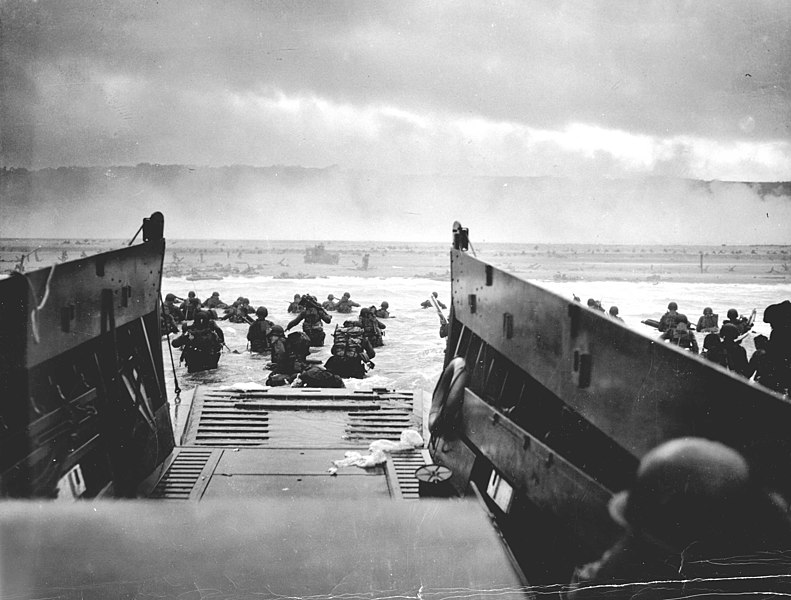
Nearly 156,000 soldiers landed (73,000 American, 61, 715 British, 21,400 Canadian) supported by 11,590 aircraft and an astounding 6,939 ships of all descriptions. By the end of the day, an estimated 10,000 of these men would be casualties; 2,500 of them were killed outright. Between 8,000 and 9,000 young Germans died as well.
Going into details of the landing and subsequent harsh fighting inland is way beyond my ability; check out iBiblio's D-Day collection for more information than you can comfortably shake a stick at.
Second, yesterday saw the passing the youngest individual to win the Medal of Honor since the Civil War.
 PFC Jacklyn "Jack" Lucas, of Plymouth, North Carolina, was born on Valentine's Day in 1928. Lucas was big for his age, and lied his way into the Marine Corps in 1942 by forging his mother's signature on his parental consent forms. He was 14 years old, but stood 5'8" tall and weighed 180 pounds. Lucas was sent to Parris Island and qualified as a sharpshooter; eventually he completed a training course enabling him to serve on a heavy machine gun crew.
Military censors were the first to cotton on to Lucas' real age, having intercepted a letter to his girlfriend (who, like Lucas, was 15). Lucas was called on the carpet to explain himself to his colonel; the officer decided that Lucas was too good a Marine to send home (he was perhaps swayed by Lucas' declaration that if discharged he would enlist in the Army), but that the teenager was far too young to go into combat. As the rest of his unit shipped out to Tarawa, a disappointed Jack Lucas found himself driving supply trucks in Hawaii.
Not content with this rear-echelon duty, Lucas took matters into his own hands. Marines who got into fights were often reassigned to combat status, so Lucas began antagonizing anyone who crossed his path. This did not have the desired result; he was arrested several times but always released shortly thereafter. When he upped the ante by fighting a sergeant, Lucas was sentenced to two 30 day penalty tours, which he described as "bread and water and a lot of rock busting."
His release from the brig warranted a celebration, and on one memorable occasion he and a buddy liberated an entire truckload of beer to treat their company. After his eleventh or twelfth drink, Lucas decided more beer was in order, and went back to see if he could find a second truckload. Thoroughly soused, the Marines attracted the notice of two MPs. One of them went for Lucas, with predictable results: "I beat the dickens out of the guy. I had 18-inch biceps in those days. I was so muscled up I could run through a brick wall." He could not, however, run through a building full of angry MPs who had seen the fight in progress.
During his subsequent incarceration, Lucas decided that this was not the way to go about getting sent overseas. After telling his buddies of his intention to join a combat unit, Lucas simply walked out of his depot, wearing fresh khakis and carrying his fatigues in a bundle under his arm. Furious officers declared him AWOL that night; after a month he would be labeled a deserter and a reward was issued for his capture.

Jack Lucas reappeared aboard the USS Deuel, in the middle of the Pacific. He had stowed away on January 9, and was lucky enough to find a cousin on board who kept him fed and hidden. The day before he would have been an official deserter, Lucas - clad once again in his best uniform - approached Captain Robert Dunlap and performed the complicated diplomatic maneuver of surrendering as a deserter while simultaneously volunteering for combat. The Deuel was loaded down with portions of the 5th Marine Division, and was en route to Iwo Jima. Doubtless, the Captain had some inkling of what lay ahead, and rightly presumed that his men would need all the help they could get, no matter what source. Lucas was presented to a colonel on board, who allowed him to stay, saying "I’d like to have a whole shipload of fellows that want to fight as bad as you." Fortunately for Lucas, the question of his age did not arise. When a Marine in the 1st Battalion, 26th Regiment came down with appendicitis, Jack Lucas was issued the man's gear and assumed his place in a rifle squad.
Lucas celebrated his 17th birthday at sea, surrounded by his new comrades.
The 26th landed on Iwo Jima on February 19, and Jack Lucas got his first taste of combat on the blasted black sand beach.
"Shells were flying, people were being blown apart, and bullets were everywhere. They made hash of us. I was as anxious as ever to kill as many Japs as I could kill. It was just where I wanted to be."
He wouldn't have to wait long to prove his mettle. Jack Lucas and his squad went out on a patrol the next day, moving towards Motoyama Airfield. After destroying a pillbox, the four Americans dove into a shallow trench for cover, and were unpleasantly surprised to find eleven Japanese soldiers in a parallel trench.
"We opened fire. There wasn’t time to put your weapon to your shoulder. We just fired off hand. This last Jap I shot, I shot him in the forehead just above the eye. My rifle jammed. I was looking down at my rifle trying to get the damned thing unjammed, and when I did I saw the grenades. I was the first to see them."
Jacklyn Lucas, barely a week into his 17th year, reacted instinctively.
"I smashed my rifle butt against one and drove it into the volcanic ash, and fell on it, and pulled the other one under me. I was there to fight, and we were there to win. What you have to do you do to win. It was not in me to turn to run.
I hollered to my pals to get out and did a Superman dive at the grenades. I wasn't a Superman after I got hit. I let out one helluva scream when that thing went off.
That volcanic ash and the good Lord saved me. If I’d been on hard ground that thing would have split me in two. There was just one explosion. One was all I could handle, and I had trouble handling that one. It blew me over on my back, and it punctured my right lung, but it never knocked me out."
Jack Lucas lay in the foxhole, bleeding from over 250 separate shrapnel wounds. Every major organ in his body had been pierced by pieces of hot, sharp metal. His right arm was twisted so far beneath his body he thought it had been blown off. Believing Lucas to be dead, his three friends forced their way out of the hole and wiped out their attackers before continuing their advance.
Lucas could only move his left hand, which he kept waving to show he was alive.
A Marine appeared at the edge of the trench. Lucas was in such bad shape that he thought he'd be mistaken for a Japanese soldier, but fortunately the other Marine recognized a comrade and called for a Corpsman. Although receiving medical attention, Lucas was far from safe - the Corpsman shot a Japanese soldier who popped up from a hole in the trench, then a mortar barrage forced them to take cover. As the stretcher bearers hurried off, one stumbled and dropped his end of the stretched. Lucas fell and split his head on a rock. "I looked up at him and smiled to let him know I knew that what he was trying to do, and I appreciated it." Lucas remembered. "I could see he was exhausted."
Lucas was evacuated to the hospital ship Samaritan (after nearly being dropped into the sea; he was saved at the last second by someone catching hold of his foot), and began a long process of recovery and rehabilitation. He would undergo 21 surgeries in the following years, and would carry over 200 pieces of metal in his body for the rest of his life - the more substantial being the size of a .22 caliber bullet. He constantly confused security at airports when he set off metal detectors time and time again.
The mark of desertion was cleared from his record, and Lucas regained his previous rating of Private First Class. On October 5, 1945, Lucas and 14 other Marines and sailors were presented with the Medal of Honor by President Truman. The teenager had no idea what the Medal of Honor was; he was not in the war to win medals, he said, but to kill the enemy. Regardless, he answered the summons to Washington and was decorated with the nation's highest military honor.
Truman said he’d rather be a Medal of Honor winner than President of the United States. I said, 'Sir, I’ll swap with you.’Life did not slow down for Jacklyn Lucas. He earned a degree in business, and started his own enterprise raising and processing beef. When the war in Vietnam broke out, Lucas joined the paratroopers and had the distinction of surviving a jump where both of his parachutes failed to open. Lucas was personally honored in President Clinton's State of the Union speech in 1995, and received a five minute standing ovation from the assembled audience. He would comment that he felt that he'd lead the life of two or three men.
He died yesterday in his hometown of Hattiesburg, Mississippi, of cancer.

(Biographical information and quotes from Jack Lucas are from William Standring's article "The Story of Jack Lucas" as published in the Marine Corps Magazine issue of Summer, 1996. Accessed through Pritzker Military Library)


No comments:
Post a Comment