
Only four of us got out of that trap whole – that any did was Sgt. Tucker’s doing – seeing that they were being methodically slaughtered, he stood up and opened fire with his rifle. As each Jap arose out of the opposing trench to fire, Tucker carefully sighted in and shot him – often, as we found out later, right between the eyes. They think that he killed about 30 Japs that way – he put two enemy machine guns out of action, and gave the others a chance to pull the wounded into nearby shell holes – bullets creased his helmet, punctured his canteen, and cut off his rifle belt, but he didn’t get down until the rest of them were safely in position.
Phil Wood letter, April 2, 1944
*NOTE: Divisional allocations of armament are based on the May, 1944 F-series division and are thus slightly different than figures for the 4th Marine Division in the Marshall Islands. The numbers are an official on-paper allocation only and do not reflect the exact numbers of each weapon carried by the 4th Division itself.
Every Marine was expected to be, first and foremost, a rifleman. Rifle training was the centerpiece of the weeks spent in boot camp; the range instructors were considered a breed apart from the shouting DIs who ran each recruit platoon, and the atmosphere during range time was markedly more serious. Whatever the Marine's eventual specialty would be - a radioman, ammo carrier for the mortars, or cook - he was expected to be able to drop everything and acquit himself well with a rifle when the chips were down.
M1903 Springfield

While antiquated when compared to the more famous M1 Garand, the '03 Springfield was still a weapon to be reckoned with in the 1940s. The first prototype appeared in 1900, and subsequent modifications (including the origination of the famous .30-06 round - so named for its caliber and year of creation) resulted in a deadly and accurate rifle; despite its adoption as the primary rifle of the American army, insufficient numbers prevented the '03 from becoming the mainstay of American infantry arms in the First World War (that distinction belongs to the M1917 Enfield).
 With the appearance of the M1 in 1936, the five shot bolt-action Springfield was officially rendered obsolete and relegated to match rifle and sniper duties. However, with the threat of war looming in 1941, armories proved incapable of producing enough Garands and the old Springfield machinery was dusted off by Remington and put back into use. The '03 Springfield was the primary rifle of the Marines in the early stages of the war; its stopping power, reliability, and accuracy made it a favorite of the Corps - so much so that some retained their old reliable even when Garands became widely available. It was particularly favored by snipers, and and the M1903A4 was specially developed to fill that role. It proved so successful that some were still being used in the Vietnam War, albeit in small numbers.
M1 Garand
The Garand is the iconic American weapon of the Second World War, and instantly outclassed other standard rifles of its type. While British, German, Russian, and Japanese soldiers were issued with bolt-action rifles, the Garand was semi-automatic, giving it a superior rate of fire. Though plagued by design problems throughout the 1930s (it was delivered as a prototype in 1924 and underwent a series of significant changes before its adoption as the standard in 1937; even then it underwent additional design changes as late as 1940), the M1 reached a production rate of nearly 600 per day by January 1941. The Army was fully equipped with M1s by the outbreak of the conflict, but the Marines were slower to adopt the new weapon, having accepted it as standard in in November, 1941. As booming enlistment numbers created a drain on the available supply, the Marines got the short end of the stick when it came to new equipment; most had to make do with the older '03 or the less than ideal Johnson rifle.
 By the time the 24th Marines were activated, sufficient M1s were available to be used in training: the photograph shows two members of the regiment at Camp Pendleton in 1943, clutching their M1s on a field problem. (USMC Photo). No longer would ill-equipped Marines be forced to "borrow" Garands from their Army counterparts.
Besides its high rate of fire, the Garand was known for accuracy, durability, and reloading speed. As the eight shot clip emptied, the clip would automatically eject (making the distinctive *ping*) and the bolt would lock back automatically. The Marine would then slam a new clip into the receiver, thus unlocking the bolt and seating the first round. Many novices failed to get their thumb out of the way before the bolt slammed home; the resulting "M1 Thumb" was a painful lesson, and as Mark Flowers wryly observes, usually only happened once.
The Garand and its variants remained in service through Korea and into Vietnam, though by then it was outclassed by its direct descendant, the M14.
5,436 Garands were allocated per division.
M1 Carbine
 The carbine version of the M1 was developed as a cross between the standard M1 service rifle and regular Marine Corps sidearms. Troops in the rear echelons, specialists like those on weapons crews, radiomen, officers, and others who would have been overburdened with a nine and a half pound Garand had had to make do with the M1911 Colt automatic or Thompson submachine gun. The Colt lacked range, and the Thompson was heavy and expensive to produce. An inexpensive yet well-ranged weapon was needed, and after a series of trials in 1941, a design by Winchester was adopted. The design was standardized in October of that year, and mass production began. The first carbines were issued in 1942, most being earmarked for troops in the ETO.
The M1 Carbine was very light, weighing in at less that 5 pounds. This weight made the weapon a hit among combat troops who were already carrying other heavy or cumbersome equipment, like a radio or machine gun. An important point to understand is that the carbine was not intended as a substitute or replacement for the standard M1 Garand service rifle; while the Garand was considered an offensive/assault weapon, the carbine was intended for use in self defense. Due to its small size, the carbine did not pack the punch or of the rifle, and complaints began to filter in about enemy soldiers taking several hits to dispatch (though these reports seem to come more heavily from the ETO, where the targets were generally physically bigger). However, the carbine had an excellent rate of fire and was fed from a 15-round magazine, enabling the trooper, soldier, or Marine to put out a lot of rounds very quickly. The low-powered round lost much of its impact after 200 yards, though recoil was considerably less, meaning that multiple aimed shots were much more possible (though early versions of the carbine did not have decent sights).
Despite the drawbacks, the M1 Carbine was overall a well-received personal weapon with some staunch supporters.
...I went around behind the position, and while they finished off the ones that were there, I waited for any that might retreat – one did, and I shot him as he tried to sneak past me in the undergrowth. I was partly, very dimly conscious that I had killed, but more aware of the satisfying way my little carbine heaved in my hands and coughed up bullets.
Phil Wood letter, April 2, 1944
It would become the most produced small arm in American military history; subcontractors included the Underwood Typewriter Company, Rock-Ola Jukebox company, General Motors, and even IBM.
10,953 M1 Carbines were allocated per division.
Sidearms & Submachine Guns
M1911A1 Pistol
 This distinctive semi-automatic pistol was the standard sidearm of American armed forces from the First World War through the early stages of Vietnam. Its origins trace to the late 1890s and the advent of self-loading pistol design. The .45 caliber M1911 was ordered into production as the service revolver of the time, the .38 Long Colt, lacked firepower and durability when used in the Philippine - American War. The pistol was officially adopted by the USMC in 1913. Nearly 1.9 million were produced during the Second World War. The M1911A1 was a common sight in each theater, though due to its limited range it was used primarily for close quarters or last-ditch combat. Many troops who were not issued this pistol acquired one through their own means, whether for additional firepower or simply for effect.
399 .45 Pistols were allocated per division.
Thompson SMG
 The famous "Tommy Gun" was born in the mud of the First World War. American General John T. Thompson, noticing the new style of trench warfare, decided that a one-man hand-held machine gun would be the armament breakthrough of the century. His project, officially entitled the "Annihilator" and colloquially known as the "Trench Broom," had most of its design flaws worked out by 1918, but the war had been won by existing weapons before a design could be finalized. The weapon was renamed the "Thompson" in 1919, and was the first weapon to be labeled and sold as a "submachine gun."
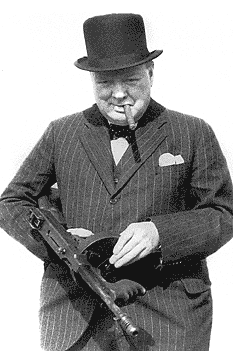
The Thompson entered mainstream production in 1921, and originally was made available to civilians (and Prime Ministers), though the high price tag limited sales (the Thompson was an exceptionally well-crafted weapon, and retailed for approximately $225). Not surprisingly, many wound up in the wrong hands, and the Tommy gun gained early notoriety as the weapon of choice for Chicago's leading gangsters. The St. Valentine's Day massacre was the most famous incident involving a Thompson gone astray, and the distinctive looking weapon appeared regularly in gangster films of the day. Thompsons were also issued to US Postal Service guards and several police precincts, and there were moderate international sales as well. The USMC received their first Thompsons in 1922 to protect against mail robberies; the gun won over the Marines in action in the Banana Wars and China.
The Thompson was the only submachine gun officially in use by the United States in 1941. The cost of production meant that supply was slow to catch up with demand. Until a cheaper method could be developed, most of the Marine Corps went into action with the sub-standard Reising SMG. The shortcomings of the Reising became apparent as soon as the weapon was taken to a jungle environment - it was a complicated, poorly-constructed firearm and prone to rusting. As newer variants of the Thompson (as well as additional M1 carbines) appeared, the Reising guns disappeared, often thrown into the jungle by disgusted Marines.
 The ultimate stripped-down version of the Thompson, the M1A1, could be produced in half the time of the previous M1928 standard, and at a fraction of the cost. Gone were the distinctive "gangster style" grip and drum barrel; in its place a more Spartan but equally as deadly weapon that remained a favorite throughout the war. Despite the advent of the M3 "Grease Gun" and the gradual withdrawal of Thompsons from active service, a considerable number were used through 1945, and the weapon still crops up in other countries in the modern day.
The Thompson was officially declared obsolete in 1971.
Only 49 Thompsons were allocated per division, though doubtless many who carried them before the reorganization held onto their "trench broom."
This distinctive semi-automatic pistol was the standard sidearm of American armed forces from the First World War through the early stages of Vietnam. Its origins trace to the late 1890s and the advent of self-loading pistol design. The .45 caliber M1911 was ordered into production as the service revolver of the time, the .38 Long Colt, lacked firepower and durability when used in the Philippine - American War. The pistol was officially adopted by the USMC in 1913. Nearly 1.9 million were produced during the Second World War. The M1911A1 was a common sight in each theater, though due to its limited range it was used primarily for close quarters or last-ditch combat. Many troops who were not issued this pistol acquired one through their own means, whether for additional firepower or simply for effect.399 .45 Pistols were allocated per division.
Thompson SMG
The famous "Tommy Gun" was born in the mud of the First World War. American General John T. Thompson, noticing the new style of trench warfare, decided that a one-man hand-held machine gun would be the armament breakthrough of the century. His project, officially entitled the "Annihilator" and colloquially known as the "Trench Broom," had most of its design flaws worked out by 1918, but the war had been won by existing weapons before a design could be finalized. The weapon was renamed the "Thompson" in 1919, and was the first weapon to be labeled and sold as a "submachine gun."The Thompson entered mainstream production in 1921, and originally was made available to civilians (and Prime Ministers), though the high price tag limited sales (the Thompson was an exceptionally well-crafted weapon, and retailed for approximately $225). Not surprisingly, many wound up in the wrong hands, and the Tommy gun gained early notoriety as the weapon of choice for Chicago's leading gangsters. The St. Valentine's Day massacre was the most famous incident involving a Thompson gone astray, and the distinctive looking weapon appeared regularly in gangster films of the day. Thompsons were also issued to US Postal Service guards and several police precincts, and there were moderate international sales as well. The USMC received their first Thompsons in 1922 to protect against mail robberies; the gun won over the Marines in action in the Banana Wars and China.
The Thompson was the only submachine gun officially in use by the United States in 1941. The cost of production meant that supply was slow to catch up with demand. Until a cheaper method could be developed, most of the Marine Corps went into action with the sub-standard Reising SMG. The shortcomings of the Reising became apparent as soon as the weapon was taken to a jungle environment - it was a complicated, poorly-constructed firearm and prone to rusting. As newer variants of the Thompson (as well as additional M1 carbines) appeared, the Reising guns disappeared, often thrown into the jungle by disgusted Marines.
The ultimate stripped-down version of the Thompson, the M1A1, could be produced in half the time of the previous M1928 standard, and at a fraction of the cost. Gone were the distinctive "gangster style" grip and drum barrel; in its place a more Spartan but equally as deadly weapon that remained a favorite throughout the war. Despite the advent of the M3 "Grease Gun" and the gradual withdrawal of Thompsons from active service, a considerable number were used through 1945, and the weapon still crops up in other countries in the modern day.The Thompson was officially declared obsolete in 1971.
Only 49 Thompsons were allocated per division, though doubtless many who carried them before the reorganization held onto their "trench broom."
Support Weapons
Browning Automatic Rifle

See entry about Corporal Howard Smith.
In this picture from Al Perry's website, Sgt. Michael Freihauf, holding the BAR, poses with Robert Tierney at Camp Maui in the spring of 1944.
853 BARs were allocated per division.
M97 Shotgun
The Winchester M97 12-gauge was a holdover from the First World War, when shotguns proved effective in clearing out trenches. Officially re-designated as "riot guns" in the interwar years, Their effectiveness was somewhat limited by their range and the deflection of shot by undergrowth, but they were a useful tool when repelling a banzai charge or clearing out bunkers.
The Winchester Model 12 was also issued. Each was a pump-action weapon holding five rounds. Because of their design, a strong man could fire the five shots as quickly as if the weapon was a semi-automatic Garand.
Use of these brutal weapons has been documented in every major Pacific island campaign. Interestingly, the shotgun seems to have been deemed useless in the ETO, and its use is almost exclusively Pacific. Other models were used in training for aircraft gunners, or for troops on guard duty.

The Marine on the left is carrying the M97 trench gun; the Marine on the right landed on Okinawa with his M12.
306 12-gauge shotguns were allocated per division.
Browning Automatic Rifle
See entry about Corporal Howard Smith.
In this picture from Al Perry's website, Sgt. Michael Freihauf, holding the BAR, poses with Robert Tierney at Camp Maui in the spring of 1944.
853 BARs were allocated per division.
M97 Shotgun
The Winchester M97 12-gauge was a holdover from the First World War, when shotguns proved effective in clearing out trenches. Officially re-designated as "riot guns" in the interwar years, Their effectiveness was somewhat limited by their range and the deflection of shot by undergrowth, but they were a useful tool when repelling a banzai charge or clearing out bunkers.
The Winchester Model 12 was also issued. Each was a pump-action weapon holding five rounds. Because of their design, a strong man could fire the five shots as quickly as if the weapon was a semi-automatic Garand.
Use of these brutal weapons has been documented in every major Pacific island campaign. Interestingly, the shotgun seems to have been deemed useless in the ETO, and its use is almost exclusively Pacific. Other models were used in training for aircraft gunners, or for troops on guard duty.
The Marine on the left is carrying the M97 trench gun; the Marine on the right landed on Okinawa with his M12.
306 12-gauge shotguns were allocated per division.


No comments:
Post a Comment