Monday, June 9, 2008

Tools of the Trade Part 1: Personal Weapons

Only four of us got out of that trap whole – that any did was Sgt. Tucker’s doing – seeing that they were being methodically slaughtered, he stood up and opened fire with his rifle. As each Jap arose out of the opposing trench to fire, Tucker carefully sighted in and shot him – often, as we found out later, right between the eyes. They think that he killed about 30 Japs that way – he put two enemy machine guns out of action, and gave the others a chance to pull the wounded into nearby shell holes – bullets creased his helmet, punctured his canteen, and cut off his rifle belt, but he didn’t get down until the rest of them were safely in position.

Phil Wood letter, April 2, 1944

*NOTE: Divisional allocations of armament are based on the May, 1944 F-series division and are thus slightly different than figures for the 4th Marine Division in the Marshall Islands. The numbers are an official on-paper allocation only and do not reflect the exact numbers of each weapon carried by the 4th Division itself.

The Rifle

Every Marine was expected to be, first and foremost, a rifleman. Rifle training was the centerpiece of the weeks spent in boot camp; the range instructors were considered a breed apart from the shouting DIs who ran each recruit platoon, and the atmosphere during range time was markedly more serious. Whatever the Marine's eventual specialty would be - a radioman, ammo carrier for the mortars, or cook - he was expected to be able to drop everything and acquit himself well with a rifle when the chips were down.

M1903 Springfield

While antiquated when compared to the more famous M1 Garand, the '03 Springfield was still a weapon to be reckoned with in the 1940s. The first prototype appeared in 1900, and subsequent modifications (including the origination of the famous .30-06 round - so named for its caliber and year of creation) resulted in a deadly and accurate rifle; despite its adoption as the primary rifle of the American army, insufficient numbers prevented the '03 from becoming the mainstay of American infantry arms in the First World War (that distinction belongs to the M1917 Enfield).

With the appearance of the M1 in 1936, the five shot bolt-action Springfield was officially rendered obsolete and relegated to match rifle and sniper duties. However, with the threat of war looming in 1941, armories proved incapable of producing enough Garands and the old Springfield machinery was dusted off by Remington and put back into use. The '03 Springfield was the primary rifle of the Marines in the early stages of the war; its stopping power, reliability, and accuracy made it a favorite of the Corps - so much so that some retained their old reliable even when Garands became widely available. It was particularly favored by snipers, and and the M1903A4 was specially developed to fill that role. It proved so successful that some were still being used in the Vietnam War, albeit in small numbers.

M1 Garand
The Garand is the iconic American weapon of the Second World War, and instantly outclassed other standard rifles of its type. While British, German, Russian, and Japanese soldiers were issued with bolt-action rifles, the Garand was semi-automatic, giving it a superior rate of fire. Though plagued by design problems throughout the 1930s (it was delivered as a prototype in 1924 and underwent a series of significant changes before its adoption as the standard in 1937; even then it underwent additional design changes as late as 1940), the M1 reached a production rate of nearly 600 per day by January 1941. The Army was fully equipped with M1s by the outbreak of the conflict, but the Marines were slower to adopt the new weapon, having accepted it as standard in
in November, 1941. As booming enlistment numbers created a drain on the available supply, the Marines got the short end of the stick when it came to new equipment; most had to make do with the older '03 or the less than ideal Johnson rifle.

By the time the 24th Marines were activated, sufficient M1s were available to be used in training: the photograph shows two members of the regiment at Camp Pendleton in 1943, clutching their M1s on a field problem. (USMC Photo). No longer would ill-equipped Marines be forced to "borrow" Garands from their Army counterparts.

Besides its high rate of fire, the Garand was known for accuracy, durability, and reloading speed. As the eight shot clip emptied, the clip would automatically eject (making the distinctive *ping*) and the bolt would lock back automatically. The Marine would then slam a new clip into the receiver, thus unlocking the bolt and seating the first round. Many novices failed to get their thumb out of the way before the bolt slammed home; the resulting "M1 Thumb" was a painful lesson, and as Mark Flowers wryly observes, usually only happened once.

The Garand and its variants remained in service through Korea and into Vietnam, though by then it was outclassed by its direct descendant, the M14.

5,436 Garands were allocated per division.

M1 Carbine
The carbine version of the M1 was developed as a cross between the standard M1 service rifle and regular Marine Corps sidearms. Troops in the rear echelons, specialists like those on weapons crews, radiomen, officers, and others who would have been overburdened with a nine and a half pound Garand had had to make do with the M1911 Colt automatic or Thompson submachine gun. The Colt lacked range, and the Thompson was heavy and expensive to produce. An inexpensive yet well-ranged weapon was needed, and after a series of trials in 1941, a design by Winchester was adopted. The design was standardized in October of that year, and mass production began. The first carbines were issued in 1942, most being earmarked for troops in the ETO.

The M1 Carbine was very light, weighing in at less that 5 pounds. This weight made the weapon a hit among combat troops who were already carrying other heavy or cumbersome equipment, like a radio or machine gun. An important point to understand is that the carbine was not intended as a substitute or replacement for the standard M1 Garand service rifle; while the Garand was considered an offensive/assault weapon, the carbine was intended for use in self defense. Due to its small size, the carbine did not pack the punch or of the rifle, and complaints began to filter in about enemy soldiers taking several hits to dispatch (though these reports seem to come more heavily from the ETO, where the targets were generally physically bigger). However, the carbine had an excellent rate of fire and was fed from a 15-round magazine, enabling the trooper, soldier, or Marine to put out a lot of rounds very quickly. The low-powered round lost much of its impact after 200 yards, though recoil was considerably less, meaning that multiple aimed shots were much more possible (though early versions of the carbine did not have decent sights).

Despite the drawbacks, the M1 Carbine was overall a well-received personal weapon with some staunch supporters.

...I went around behind the position, and while they finished off the ones that were there, I waited for any that might retreat – one did, and I shot him as he tried to sneak past me in the undergrowth. I was partly, very dimly conscious that I had killed, but more aware of the satisfying way my little carbine heaved in my hands and coughed up bullets.

Phil Wood letter, April 2, 1944


It would become the most produced small arm in American military history; subcontractors included the Underwood Typewriter Company, Rock-Ola Jukebox company, General Motors, and even IBM.

10,953 M1 Carbines were allocated per division.

Sidearms & Submachine Guns

M1911A1 Pistol
This distinctive semi-automatic pistol was the standard sidearm of American armed forces from the First World War through the early stages of Vietnam. Its origins trace to the late 1890s and the advent of self-loading pistol design. The .45 caliber M1911 was ordered into production as the service revolver of the time, the .38 Long Colt, lacked firepower and durability when used in the Philippine - American War. The pistol was officially adopted by the USMC in 1913. Nearly 1.9 million were produced during the Second World War. The M1911A1 was a common sight in each theater, though due to its limited range it was used primarily for close quarters or last-ditch combat. Many troops who were not issued this pistol acquired one through their own means, whether for additional firepower or simply for effect.

399 .45 Pistols were allocated per division.

Thompson SMG
The famous "Tommy Gun" was born in the mud of the First World War. American General John T. Thompson, noticing the new style of trench warfare, decided that a one-man hand-held machine gun would be the armament breakthrough of the century. His project, officially entitled the "Annihilator" and colloquially known as the "Trench Broom," had most of its design flaws worked out by 1918, but the war had been won by existing weapons before a design could be finalized. The weapon was renamed the "Thompson" in 1919, and was the first weapon to be labeled and sold as a "submachine gun."
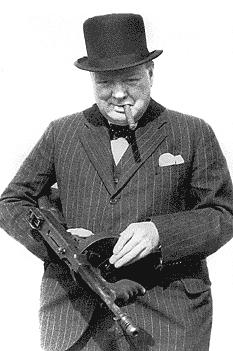
The Thompson entered mainstream production in 1921, and originally was made available to civilians (and Prime Ministers), though the high price tag limited sales (the Thompson was an exceptionally well-crafted weapon, and retailed for approximately $225). Not surprisingly, many wound up in the wrong hands, and the Tommy gun gained early notoriety as the weapon of choice for Chicago's leading gangsters. The St. Valentine's Day massacre was the most famous incident involving a Thompson gone astray, and the distinctive looking weapon appeared regularly in gangster films of the day. Thompsons were also issued to US Postal Service guards and several police precincts, and there were moderate international sales as well. The USMC received their first Thompsons in 1922 to protect against mail robberies; the gun won over the Marines in action in the Banana Wars and China.

The Thompson was the only submachine gun officially in use by the United States in 1941. The cost of production meant that supply was slow to catch up with demand. Until a cheaper method could be developed, most of the Marine Corps went into action with the sub-standard Reising SMG. The shortcomings of the Reising became apparent as soon as the weapon was taken to a jungle environment - it was a complicated, poorly-constructed firearm and prone to rusting. As newer variants of the Thompson (as well as additional M1 carbines) appeared, the Reising guns disappeared, often thrown into the jungle by disgusted Marines.

The ultimate stripped-down version of the Thompson, the M1A1, could be produced in half the time of the previous M1928 standard, and at a fraction of the cost. Gone were the distinctive "gangster style" grip and drum barrel; in its place a more Spartan but equally as deadly weapon that remained a favorite throughout the war. Despite the advent of the M3 "Grease Gun" and the gradual withdrawal of Thompsons from active service, a considerable number were used through 1945, and the weapon still crops up in other countries in the modern day.

The Thompson was officially declared obsolete in 1971.

Only 49 Thompsons were allocated per division, though doubtless many who carried them before the reorganization held onto their "trench broom."

Support Weapons

Browning Automatic Rifle


See entry about Corporal Howard Smith.

In this picture from Al Perry's website, Sgt. Michael Freihauf, holding the BAR, poses with Robert Tierney at Camp Maui in the spring of 1944.


853 BARs were allocated per division.


M97 Shotgun
The Winchester M97 12-gauge was a holdover from the First World War, when shotguns proved effective in clearing out trenches. Officially re-designated as "riot guns" in the interwar years, Their effectiveness was somewhat limited by their range and the deflection of shot by undergrowth, but they were a useful tool when repelling a banzai charge or clearing out bunkers.

The Winchester Model 12 was also issued. Each was a pump-action weapon holding five rounds. Because of their design, a strong man could fire the five shots as quickly as if the weapon was a semi-automatic Garand.

Use of these brutal weapons has been documented in every major Pacific island campaign. Interestingly, the shotgun seems to have been deemed useless in the ETO, and its use is almost exclusively Pacific. Other models were used in training for aircraft gunners, or for troops on guard duty.

The Marine on the left is carrying the M97 trench gun; the Marine on the right landed on Okinawa with his M12.

306 12-gauge shotguns were allocated per division.

Today (and Yesterday) in Company History, 1944

On Shipboard
June 8, 1944

Dear girls,

News last night, by wireless, of the invasion. Cheering hadn’t died down before I suddenly got a flash realization that this war may be over in our time. For so long now it has seemed that the war would last indefinitely – just couldn’t see the end of it, stretching on for a couple of years at least. But now, with luck, it is possible at last that I might be home by a year from now, with no more than a couple more campaigns under my belt. Seems impossible of course, but it could happen. God knows, I’ve never wanted anything so much in my life.

Nothing much has been happening. A lot of briefing, and exercising in the steaming heat. Played a lot of Monopoly, of all things. In fact, it’s quite the rage, the Red Cross having broken out with a couple dozen games – it’s ideal for passing away the time. Also playing some bridge – wisely I didn’t bring much money, so I can’t play poker. Funny, though, how much time you can waste, just in the daily business of living – showers, sleep, eating – only an hour or two of real work in the day, and yet somehow the rest of it passes.

One has to be in the mood to write a letter, or it is worse than none at all – I’m not in it this afternoon – maybe tomorrow.

Love,

Eagle


Able Company and the rest of the 24th were still on their transports, in the vicinity of Eniwetok Lagoon where the assault force was assembling for the final voyage to Saipan.

As Phil Wood notes, there wasn't much to do except kill time, attend the lectures, exercise, and wait.


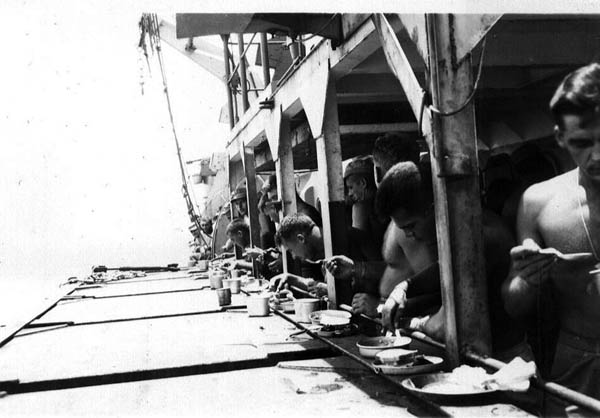
Chow time for Marines aboard an LST.
(photo from www.lst794.org.)

Friday, June 6, 2008

The Longest Day & The Youngest MOH

While not strictly related to A Company, there are two important things to note about today.

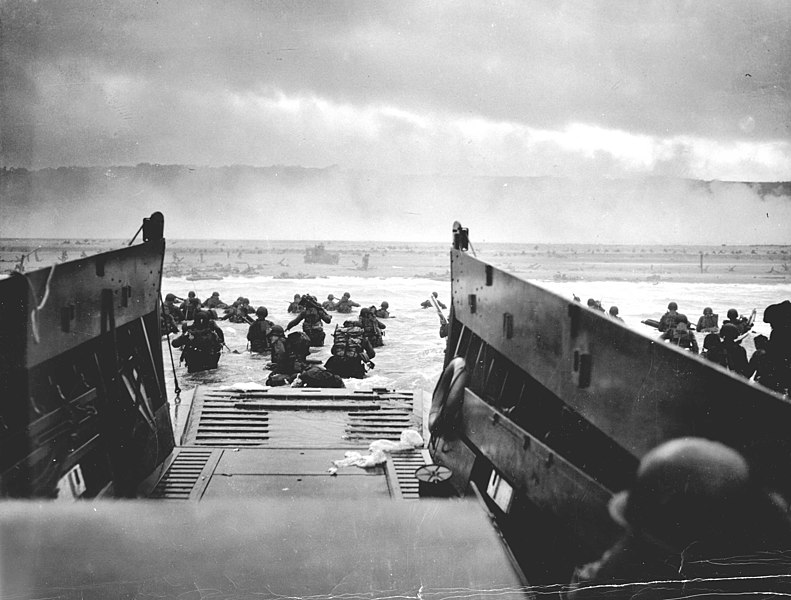
First, it is of course June 6. Sixty four years ago today, Allied troops landed in the fields and on the beaches of Normandy to begin the invasion of Fortress Europe.


Nearly 156,000 soldiers landed (73,000 American, 61, 715 British, 21,400 Canadian) supported by 11,590 aircraft and an astounding 6,939 ships of all descriptions. By the end of the day, an estimated 10,000 of these men would be casualties; 2,500 of them were killed outright. Between 8,000 and 9,000 young Germans died as well.

Going into details of the landing and subsequent harsh fighting inland is way beyond my ability; check out iBiblio's D-Day collection for more information than you can comfortably shake a stick at.


Second, yesterday saw the passing the youngest individual to win the Medal of Honor since the Civil War.

PFC Jacklyn "Jack" Lucas, of Plymouth, North Carolina, was born on Valentine's Day in 1928. Lucas was big for his age, and lied his way into the Marine Corps in 1942 by forging his mother's signature on his parental consent forms. He was 14 years old, but stood 5'8" tall and weighed 180 pounds. Lucas was sent to Parris Island and qualified as a sharpshooter; eventually he completed a training course enabling him to serve on a heavy machine gun crew.

Military censors were the first to cotton on to Lucas' real age, having intercepted a letter to his girlfriend (who, like Lucas, was 15). Lucas was called on the carpet to explain himself to his colonel; the officer decided that Lucas was too good a Marine to send home (he was perhaps swayed by Lucas' declaration that if discharged he would enlist in the Army), but that the teenager was far too young to go into combat. As the rest of his unit shipped out to Tarawa, a disappointed Jack Lucas found himself driving supply trucks in Hawaii.

Not content with this rear-echelon duty, Lucas took matters into his own hands. Marines who got into fights were often reassigned to combat status, so Lucas began antagonizing anyone who crossed his path. This did not have the desired result; he was arrested several times but always released shortly thereafter. When he upped the ante by fighting a sergeant, Lucas was sentenced to two 30 day penalty tours, which he described as "bread and water and a lot of rock busting."

His release from the brig warranted a celebration, and on one memorable occasion he and a buddy liberated an entire truckload of beer to treat their company. After his eleventh or twelfth drink, Lucas decided more beer was in order, and went back to see if he could find a second truckload. Thoroughly soused, the Marines attracted the notice of two MPs. One of them went for Lucas, with predictable results: "I beat the dickens out of the guy. I had 18-inch biceps in those days. I was so muscled up I could run through a brick wall." He could not, however, run through a building full of angry MPs who had seen the fight in progress.

During his subsequent incarceration, Lucas decided that this was not the way to go about getting sent overseas. After telling his buddies of his intention to join a combat unit, Lucas simply walked out of his depot, wearing fresh khakis and carrying his fatigues in a bundle under his arm. Furious officers declared him AWOL that night; after a month he would be labeled a deserter and a reward was issued for his capture.

Jack Lucas reappeared aboard the USS Deuel, in the middle of the Pacific. He had stowed away on January 9, and was lucky enough to find a cousin on board who kept him fed and hidden. The day before he would have been an official deserter, Lucas - clad once again in his best uniform - approached Captain Robert Dunlap and performed the complicated diplomatic maneuver of surrendering as a deserter while simultaneously volunteering for combat. The Deuel was loaded down with portions of the 5th Marine Division, and was en route to Iwo Jima. Doubtless, the Captain had some inkling of what lay ahead, and rightly presumed that his men would need all the help they could get, no matter what source. Lucas was presented to a colonel on board, who allowed him to stay, saying "I’d like to have a whole shipload of fellows that want to fight as bad as you." Fortunately for Lucas, the question of his age did not arise. When a Marine in the 1st Battalion, 26th Regiment came down with appendicitis, Jack Lucas was issued the man's gear and assumed his place in a rifle squad.

Lucas celebrated his 17th birthday at sea, surrounded by his new comrades.

The 26th landed on Iwo Jima on February 19, and Jack Lucas got his first taste of combat on the blasted black sand beach.

"Shells were flying, people were being blown apart, and bullets were everywhere. They made hash of us. I was as anxious as ever to kill as many Japs as I could kill. It was just where I wanted to be."

He wouldn't have to wait long to prove his mettle. Jack Lucas and his squad went out on a patrol the next day, moving towards Motoyama Airfield. After destroying a pillbox, the four Americans dove into a shallow trench for cover, and were unpleasantly surprised to find eleven Japanese soldiers in a parallel trench.

"We opened fire. There wasn’t time to put your weapon to your shoulder. We just fired off hand. This last Jap I shot, I shot him in the forehead just above the eye. My rifle jammed. I was looking down at my rifle trying to get the damned thing unjammed, and when I did I saw the grenades. I was the first to see them."

Jacklyn Lucas, barely a week into his 17th year, reacted instinctively.

"I smashed my rifle butt against one and drove it into the volcanic ash, and fell on it, and pulled the other one under me. I was there to fight, and we were there to win. What you have to do you do to win. It was not in me to turn to run.

I hollered to my pals to get out and did a Superman dive at the grenades. I wasn't a Superman after I got hit. I let out one helluva scream when that thing went off.

That volcanic ash and the good Lord saved me. If I’d been on hard ground that thing would have split me in two. There was just one explosion. One was all I could handle, and I had trouble handling that one. It blew me over on my back, and it punctured my right lung, but it never knocked me out."


Jack Lucas lay in the foxhole, bleeding from over 250 separate shrapnel wounds. Every major organ in his body had been pierced by pieces of hot, sharp metal. His right arm was twisted so far beneath his body he thought it had been blown off. Believing Lucas to be dead, his three friends forced their way out of the hole and wiped out their attackers before continuing their advance.

Lucas could only move his left hand, which he kept waving to show he was alive.

A Marine appeared at the edge of the trench. Lucas was in such bad shape that he thought he'd be mistaken for a Japanese soldier, but fortunately the other Marine recognized a comrade and called for a Corpsman. Although receiving medical attention, Lucas was far from safe - the Corpsman shot a Japanese soldier who popped up from a hole in the trench, then a mortar barrage forced them to take cover. As the stretcher bearers hurried off, one stumbled and dropped his end of the stretched. Lucas fell and split his head on a rock. "I looked up at him and smiled to let him know I knew that what he was trying to do, and I appreciated it." Lucas remembered. "I could see he was exhausted."

Lucas was evacuated to the hospital ship Samaritan (after nearly being dropped into the sea; he was saved at the last second by someone catching hold of his foot), and began a long process of recovery and rehabilitation. He would undergo 21 surgeries in the following years, and would carry over 200 pieces of metal in his body for the rest of his life - the more substantial being the size of a .22 caliber bullet. He constantly confused security at airports when he set off metal detectors time and time again.

The mark of desertion was cleared from his record, and Lucas regained his previous rating of Private First Class. On October 5, 1945, Lucas and 14 other Marines and sailors were presented with the Medal of Honor by President Truman. The teenager had no idea what the Medal of Honor was; he was not in the war to win medals, he said, but to kill the enemy. Regardless, he answered the summons to Washington and was decorated with the nation's highest military honor.
Truman said he’d rather be a Medal of Honor winner than President of the United States. I said, 'Sir, I’ll swap with you.’
Life did not slow down for Jacklyn Lucas. He earned a degree in business, and started his own enterprise raising and processing beef. When the war in Vietnam broke out, Lucas joined the paratroopers and had the distinction of surviving a jump where both of his parachutes failed to open. Lucas was personally honored in President Clinton's State of the Union speech in 1995, and received a five minute standing ovation from the assembled audience. He would comment that he felt that he'd lead the life of two or three men.

He died yesterday in his hometown of Hattiesburg, Mississippi, of cancer.

Jack Lucas with reenactors at the 60th Anniversary battle of Iwo Jima
(from Hardscrabble Farm)

(Biographical information and quotes from Jack Lucas are from William Standring's article "The Story of Jack Lucas" as published in the Marine Corps Magazine issue of Summer, 1996. Accessed through Pritzker Military Library)

Wednesday, June 4, 2008

Training for Saipan

With the big fight for Saipan looming in the next weeks, this is probably a good time to go into a little background on the training that the 24th Marines underwent to prepare for the battle.

(R&R at Camp Maui will be another topic for another time).

The 24th sailed from Namur on February 23, 1944, exactly a month after they departed from San Diego en route to Operation Flintlock. Their experiences in combat weighed heavily on many of the men, as Phil Wood describes:

Well, we left San Diego just a month ago today – and we have now started back - not all the way, but to a rest camp. Rest Camp isn’t exactly and accurate term – more like a prizefighter’s training camp, where you go to put on weight, get back in trim. We need some of that – a lot of new equipment to replace all that was lost or damaged, and a chance to relax the boys’ minds – they’ve been under a tension for a long time now. All they – we - want to do is get back to some safe spot and eat and sleep and loaf in the sun – and see some green hills and foamy cold beer, and see a buxom open-faced country lass.

Phil Wood letter, February 23 1944

The 24th returned to a newly established rest camp on Maui (appropriately, if not imaginatively, named "Camp Maui"). The tired Marines were given a chance to rest, recuperate from their experiences, and in some cases, recover in the hospital. The camp itself was scarcely an ideal living place; the official USMC Monograph for Saipan notes that "...the 4th Division's camp on Maui were incomplete in many respects. Considerable time was necessarily spent making these camps liveable. At Camp Maui, the ubiquitous red clay caused much annoyance. In dry weather, everything was covered with red dust, in wet weather, with red mud." However, from a training standpoint, the conditions were excellent. Camp Maui possessed the only 100-target rifle range in the entire PTO, and artillery crews enjoyed huge amounts of space to practice dropping high explosive rounds on target.

The 4th Marine Division website has an excellent summary of the facilities available for the Marines:

The terrain and beaches of Maui provided excellent and rugged training ground. All the Division's amphibious maneuvers for the Marianas and Iwo Jima operations were held off Maalaea Bay. Haleakala became a super obstacle course and 13-mile hikes through its crater, a challenge to those who thought they had tough leg muscles. A total of 47 training areas, many of them belonging to the Army, were available to the Division. Six areas, consisting of gulches and rough terrain, near the camp, were used for non-tactical maneuvering. On the outskirts of camp, a demolitions area, a live-grenade course, a pistol range, and 1000-inch machine-gun range were set up. Five miles east of camp, in a gulch opening into the sea, was the Division's bazooka area, and along the coast, east of camp for about ten miles, were combat firing ranges which permitted the maneuvering and firing of tanks and halftracks in coordination with the infantry. The Division's 100-target rifle range at Opana Point was also located in this area. Another area in the vicinity was used to train motor transport drivers in the movement of troops and supplies under both day and night conditions of combat.

Army facilities on Maui available to the Division, according to Fourth Division records, "consisted of a jungle training center, a village fighting course, a cave fighting course, and an infiltration course. The fortified jungle position consisted of 22 pillboxes and emplacements well concealed in bamboo groves, under the roots of banyan trees, and in thick undergrowth."

In addition to all this, there was a mortar and artillery impact area, a seacoast artillery range and an antiaircraft firing area. The Maalaea Bay area furnished an antitank moving-target range, a close-combat range, and a 20-point rifle range. The beach at Maalaea Bay was fortified with pillboxes and emplacements modeled after the Tarawa Beach. Inland were two artillery positions and maneuver areas. In the center of the island, near the Puunene Air Station, were, the Division's tank maneuver areas.


Preparations for Operation Forager began shortly after the Division arrived on Maui.

Life here is not bad at all – they call it a rest camp, and strangely enough they almost mean it. We didn’t do anything the first week except get squared away, and now we have a light training schedule – with the emphasis on athletics and recreation.

Phil Wood letter, February 27, 1944

As mentioned before, the Division underwent a reorganization at this time. John C. Chapin, then a Lieutenant leading a rifle platoon in 3/24 and now the historian for the 4th Marine Division, summarized the reorganization in his pamphlet "Breaching the Marianas: The Battle for Saipan."

The training before Saipan was based on a new Table of Reorganization for the Marine divisions. Their sized was reduced by 2,500 men to 17,465. The artillery regiments each lost one of its 75mm pack howitzer battalions, but the infantry retained its previous units. Rifle squads, however, were reorganized to total 13, using three "fire teams" of four men with each team built around a Browning automatic rifle (BAR), a 50 percent increase in the division of this valuable weapon. The number of 60mm mortars in the division table of equipment was similarly expanded, while the number of flamethrowers grew ten-fold. In addition, the tank battalions were able to replace their antiquated light tanks with mediums.

Lt. Chapin also remembered his personal experience:

(These) months were busy, hard-working ones. The replacements that arrived to fill the gaps left by Namur's casualties (in the Kwajalein battle) had to be trained in all the complexities of field work. Most of these replacements were boys fresh from boot camp, and they were ignorant of everything but the barest essentials. Week after week was filled with long marches, field combat problems, live firing, obstacle courses, street fighting, judo, calisthenics, night and day attacks and defenses, etc. There were also lectures on the errors we'd made at Namur. Added emphasis was placed on attacking fortified positions. We worked with demolition charges of dynamite, TNT, and C-2, and with flame throwers till everyone knew them forward and backward.

John C. Chapin, "Breaching the Marianas: The Battle for Saipan."


In addition to the full schedule that Lt. Chapin mentioned, the Marines were also taught a selection of phrases in Japanese - namely, "Hands Up," "Hurry Up," "Come out and we will give you food," and the like. Generally, these lessons were given immediately before the evening movie, which was always well attended.

By March, rules and restrictions were beginning to tighten up.

We missed our liberty, because we failed to pass Col. Hart’s inspection – things are very G.I. around here – I expected a relaxation on that stuff on the theory that all hands are tired, to some extent at least. But Hell no – it’s worse than it ever was. And it’s the petty stuff that I can’t stand. The one thing that makes it positive that I won’t stay in the Corps in peacetime.

That is pretty harsh punishment – it makes it 19 days with no liberty – not that 9 AM to 10 PM is much liberty time anyway, but the boys cry for all they can get, naturally.

Phil Wood letter, March 16, 1944


It’s raining again. It rains fully half the time. I fully expect Jeanne Eagles [sic] to come swinging into the tent – and it rains with a painful regularity every time we go out into the field. And that is no fun, let me tell you – hiking in wet feet – crawling on your belly in ankle deep mud – sleeping in two inches of water, and the mosquitoes.

And when we are not out on maneuvers we are being inspected by Colonels and Generals – and they are never satisfied – we had one liberty day taken away for it. And washing gear and clothes – then trying to get them dry. In fact, the maneuvers are designed to get our gear dirty so that we’ll have something to clean for the next inspection.

Phil Wood letter, March 31, 1944.

Training intensified as March became April.
We were in the field for a long time – we covered many a mile on these dogs of mine – a lot of firing. We’ve been able to get more ammo on here than we ever got back in the States. It’s been a long, tiring session, but nobody minded it too much. We knew we had to get back into condition, and there were a lot of things we had to learn – mistakes we made last time and how to correct them – new angles to suit the different types of fighting we’re going to do next time. The Marine Corps is really damned good on that angle – preparation and careful planning. We rehearsed our methods and attack formula months before we left Pendleton, though we didn’t know it at that time. It’s the kind of foresight that pays dividends.

Phil Wood letter, April 28, 1944
The 24th Marines, in their designation as a diversionary force, skipped some of the assault landing practice required of the 23rd and 25th Marines, and instead participated in boat exercises at the Maui Amphibious Training Center.

As May commenced, individual practice gave way to large unit maneuvers, practice landings, and dress rehearsals for the event itself, and everyone knew that another move was pending.

No sensational news, except that we’ve been doing a lot of work lately. Except for those pretty grim inspections, we had little to do for the first six weeks after we got here, but the last six weeks have been spent getting us back into shape – and we are in good shape now. “Don’t send any more V-Mail, only Air Mail” is all that I’m allowed to say.

Phil Wood letter, May 6, 1944


On May 17, both the 2nd and 4th Divisions launched a full-scale mock assault, replicating the tactics and objectives they would face on Saipan. This was followed on May 19 by a second assault practice which took place under a live Navy bombardment. The general staff felt that the exercises had proceeded wonderfully; however, the junior grade officers were less impressed.

To us in the lower echelons it was just the same old stuff that we'd been doing for a solid year: filing up from compartments below decks to your assigned boat station, going over the side, hurrying down the net to beat the stopwatch, into the heaving LCVP (Landing Craft, Vehicle, Personnel), and away. Then the interminable hours of circling, meanwhile getting wet, hungry and bored. The K rations (in a waxed box) tasted like sawdust; the weather got rougher and rougher. Some of the men got seasick, and all of us were soaking wet and cold.

Finally we headed back to our transport and clambered up the cargo net with a sigh of relief. The next day it was the same thing all over again, except that this time we went ashore. This, too, had an awfully familiar feeling: wading through the surf, getting your only pair of shoes and socks wringing wet, and then onto the beach where all the sand migrated inside your shoes. A series of conflicting and confusing orders flowed down through the chain of command: halt and move on, halt and move on, go here, go there.

John C. Chapin, "Breaching the Marianas: The Battle for Saipan."


The 4th Division set sail at the end of May, crowded onto their LST transports. The Marines were not informed of their target until the ships were safely away; once the name Saipan was mentioned, many must have wondered if they would ever return to the dusty red ground of Camp Maui.


Alva Perry, Robert Fleischauer, Robert Tierney, and "Tojo" - a souvenir of Namur - at Camp Maui.

Fleischauer and Tierney were both wounded on Saipan; the former passed away a few years ago while the latter is one of the surviving members of A Company.

Tojo's ultimate fate is unknown, though one hopes it was better than that of his namesake.


"3rd Squad" on Maui shortly before shipping out to Saipan.

Standing, from left:
Mike Freihauf (KIA Tinian)
Andy Loban (KIA Iwo Jima)
Robert Wynne
Robert McGinnai
Paul Scanlon
Herbert Maurite
Robert Tierney (WIA Saipan)


Seated, from left:
Joseph Wendt
George Marion
Kenneth Grey (KIA Iwo Jima)
Lee Anderson

(The previous pictures are from Al Perry's website.)

At This Point:

I am going to try to start doing a This Day In Company History feature. Generally, it'll be a broad overview of what the Regiment / Division was up to, as that is most often recorded, but if more details are available at the Battalion or Company level, those will be added with as much detail as possible.

This particular day isn't of any special note. The 4th Marine Division, as part of the Northern Attack Force, Group One, embarked on their transports to Saipan on May 29th, and were en route to Eniwetok Lagoon, the staging area for the assault itself. The 23rd and 25th Marines would hit beaches codenamed Blue and Yellow, respectively, while the 24th was slated to take part in a diversionary maneuver near Tanapag Harbor (along with the 2nd and 1/29th Marines of the 2nd Marine Division).

While on the transports, the name of the target was finally revealed to the Marines, and each individual was instructed as to the part he would play in the coming attack. Instructive schools were held and maps and photographs were provided to all units, until everyone knew his role backward and forward.

Tuesday, June 3, 2008

Organization

Continuing our trend of general information entries (can one previous entry be considered a "trend?" Perhaps not, but regardless...), today will feature a discussion on the organization of a Marine Corps unit, from the Divisional level on down.

The Division

Of course, our case study will be the 4th Marine Division. Much of this information is coming from Mark Flowers' excellent site, World War Two Gyrene.

The basic Divisional structure of the Marine Corps has remained the same from its inception in March, 1941. Prior to this, the Marines had been organized into units the size of brigades or smaller, but as the 1920s progressed and the lessons of the First World War were digested (and projected over the Pacific with a cautious eye on Japan), it was decided that the brigade level was simply too small a unit to conduct independent operations. The Fleet Marine Force, created in 1933 by Secretary of the Navy Claude Swanson, provided the building blocks for the 1st and 2nd Marine Divisions. Under this new structure, two new brigades were created; one posted to the East Coast and one to the West.

Each Division was composed of three infantry regiments, with one artillery regiment and one tank battalion providing fire support. Further components included headquarters, motor transport, service, pioneer, and medical units, which ensured that each Division was fully capable of operating as a separate entity.

(A quick note on medical support: during World War 2, the USMC did not have its own medical branch. The wounded Marine counted on the aid of a Navy Corpsman who would be attached to his unit, which is why Ryan Philippe's character in "Flags Of Our Fathers" wears Navy dress whites instead of a Marine uniform. On the battlefield, any exchange of fire would usually be followed by cries for "Sailor!" as Japanese soldiers were fond of calling "Corpsman!" in an attempt to lure a luckless American into exposing himself.)

As the Marines gained experience in 1942 and 1943, the divisional structure changed. When the 4th Marine Division was activated on 16th August, 1943, they became part of the third structure, T/O E-100.

(Complete organizational table USMC Operations in WWII, Vol. 2: Isolation of Rabaul)

The 4th Marine Division was composed of the following elements:

23rd Marines (Infantry)
24th Marines (Infantry)
25th Marines (Infantry)

14th Marines (Artillery)

20th Marines (Engineers - from June 1943 to August 1944)

Headquarters Battalion
4th Tank Battalion
4th Engineer Battalion
4th Pioneer Battalion
4th Service Battalion
4th Medical Battalion
4th Motor Transport Battalion

In May, 1944, as the Division rested after the campaign for the Marshall Islands, they were again reorganized and expanded, this time into the F-100 series.

(Complete organizational table USMC Operations in WWII, Vol. 4: Western Pacific Operations)

The 4th Marine Division remained in this configuration through Saipan, Tinian, and Iwo Jima. Other Marine divisions would be reorganized into a further G-series, but fortunately the 4th was out of combat by that time.


Happy Marines aboard CVE Attu, bound for the States at last.


The 4th Marine Division was under the command of Major General Harry Schmidt.


The Regiment
The 24th Marines, as a typical Marine Infantry regiment, was composed of three separate Battalions and Headquarters staff. Their commanding officer was Colonel Franklin A. "Rusty" Hart, until his promotion to Brigadier General (thus becoming the Assistant Division Commander).

Colonel Hart was succeeded by Colonel Walter Jordan, who commanded the regiment at Iwo Jima.

The Battalion
A Marine Corps Battalion was composed of three rifle companies, one Weapons company, and a Headquarters/Staff section. It fell under the command of Lieutenant Colonel. First Battalion, 24th Marines went through several commanders during the War.

- Lt. Colonel Aquilla "Red" Dyess, the Medal of Honor recipient noted below, was killed February 2, 1944.

- Lt. Colonel Maynard "Heinie" Schultz died of wounds received on June 15, 1944 as the Battalion landed on Saipan. Captain Schechter of A Company recalled:

Sometime that first afternoon I received word that we had once again lost a battalion commander. His name was Lieutenant Colonel Nayard Schultz [sic], but we called him Heinie. He was a big guy, from Detroit, I believe. He took a piece of shrapnel in his head. It was a small sliver so it had to hit him in just the right spot to kill him.

Captain Irving Schechter, 1982, quoted in Henry Berry's "Semper Fi, Mac."
- Major Robert Fricke, the Battalion Executive Officer, served as Battalion Commander for a brief two days (June 16-18).

- Lt. Colonel Austin Brunelli, the Regimental Executive Officer, replaced Fricke (reason unknown) and served until July 4, 1944, when he ceded command and returned to his position as XO.

- Lt. Colonel Otto Lessing, previously commanding 3rd Battalion, moved to 1st Battalion on July 4. Lessing was a Marine's officer, and had the safety and best interests of his men at heart, as he demonstrated at his own expense on Tinian. Again, Captain Schechter's account:

Lessing was not only a top officer but he also had an interesting background.

His parents had separated when he was a kid. His mother was an American and his father was a German and an ardent Nazi. As a matter of fact, the senior Lessing was one of Hitler's top censors in Berlin. Maybe this was why Otto tried to be such an outstanding Marine.

At any rate, we had been on the go for seven days, always facing some resistance. We hadn't had any food other than our regular combat rations. I should also point out that we had run into some heavy rain. In short, things were pretty miserable.

Then I received a call from headquarters. I don't want to mention any names, but it was from a pretty high source who claimed he was interested in finding out how my men were.

"Just about done," I told him. "Perhaps it's time to pull them out."

"Oh, we're all shot," he answered. "Why, I have a slight touch of dysentery myself."

Oh, my God, I thought, he's back there on the beach with hot rations, coffee, the whole works and he has a slight case of the runs. Tough.

"Schechter," the ranking officer continued, "I have a bet with someone over in the 2nd Division that we will take Tinian before they do."

Now I was thunderstruck. How the hell could anyone make a bet like that, playing with other people's lives? But our orders were to keep going and we did.

I won't go into details, but a little later I received orders to go into an area that meant certain disaster. I complained to Colonel Lessing, who sympathized with me, and even tried to get a hold put on the orders but was unsuccessful.

I started to execute these orders, but the first three Marines in line were immediately killed. That was enough for me. I had the three bodies put in ponchos and sent word back that I just didn't have the clout to go any further.

Shortly after this Colonel Lessing showed up. He spotted the ponchos.

"Buck," he said, "what's this?"

"Colonel," I answered, "that's the bodies of the first three men who tried to move into the area I told you about. We just don't have to end up putting what's left of my company into ponchos because someone back on the beach is a nut."

So Colonel Lessing picked up the phone and called back to the beach. He was obviously asked how things were going where we were.

"Not so good," he said. "I'm staring at three Marines who are covered with ponchos because of that stupid order I tried to get changed. I hate waste."

That was it. In the movies Colonel Lessing would be a big hero, as he was to me, but in the real world he was relieved of his command. I don't know if he's still alive, but if he is, I'd like him to know I salute him.

Anyway, things like that happened.

Captain Irving Schechter, 1982, quoted in Henry Berry's "Semper Fi, Mac."
- Major Paul Treitel succeeded Lessing. He was a career Marine and had held a commission before the War. Irving Schechter, by now a Major and the battalion's Operations Officer, remembered Treitel as well:

The battalion's commander was an Annapolis graduate named Major Paul Treitel. He was a career man and naturally resented the fact that he hadn't been made lieutenant colonel, the rank his job called for. Regular officers were always more concerned about their rank than reserve officers. After all, they meant to wear the green uniforms when the rest of us became civilians.


As the horrific casualties on Iwo Jima chewed the regiment to pieces, Major Schechter went back to combat command (of his old Company A, though losses reduced the battalion to two ragged companies instead of the usual four). That was not the only change in command structure on March 8, 1945:

It was then that Lieutenant Colonel Brunelli took over command of our battalion; he had been the regiment's executive officer. I can't remember if Paul Treitel was wounded or just used up. Treitel had been in command for sixteen days and very few battalion commanders lasted through the whole campaign.

Captain Irving Schechter, 1982, quoted in Henry Berry's "Semper Fi, Mac."
- Lt. Colonel Austin Brunelli would win the Navy Cross for his actions as Battalion C/O. He had been recently wounded, and just returned to active duty when he assumed command of the battalion. Brunelli saw out the war with 1st Battalion, and went on to become a Brigadier General.

The Company
Company A was one of twelve in the Regiment, and one of four in 1st Battalion. Companies were named Able, Baker, Charlie, Dog, Fox, Easy, Golf, How, Item, King, Love, and Mike. (I've never seen reference to "Jig" company, and believe this to be a carryover from the days when orders were handwritten - American Civil War regiments, for example, never had a "Company J" due to possible confusion with "Company I"). Each Company was commanded by a Captain.

Company A was commanded by Captain Irving Schechter until his promotion to Major and his reassignment to battalion staff. His successor, "a graduate of the Citadel" lasted only a few days on Iwo Jima. Major Schechter resumed command of his mauled Company on March 8, and remained with them for the remainder of the battle.

Rifle companies were composed of three Rifle Platoons and one Weapons Platoon; the Weapons Company would feature detachments of heavy weapons (the 81mm mortar, 37mm anti-tank gun, .50 cal M2 machine gun, etc).

The Platoon
Each Platoon was commanded by a Lieutenant; each contained a series of Squads. At the Platoon level, the reorganization of the E-series (remember that?) was most noticeable.

We have a new organization – I have six squads now instead of four, and three mortars and three machine guns, and forty men instead of 28.

Phil Wood letter, February 1943 (New River, NC)

In company formation we were the fourth platoon, the other three being rifle platoons, all with a Lieutenant as a Platoon Leader. Phil was our Platoon Leader, in fact he was the only one we ever had until he was killed. Prior to coming west we had four squads, three with two machines guns each and a mortar squad of two tubes. While at Pendleton they change [sic] the organization and gave us six squads, we added a gun squad with two more guns and a mortar squad with two additional tubes. Unlike the rifle platoons who worked as a unit, weapons were broken down with a gun squad assigned to each rifle platoon, this was each rifle platoon had it's own automatic weapons in a firefight right there rather than having to call them up. The extra two guns stayed with the Lt. and the tubes at the command center. No matter how we were deployed, Phil was our Lieutenant.

George Smith, personal recollection.

There have been many changes made in our outfit – most of them caused, not by casualties, but by Col. Hart’s belief that we have been too long in our present jobs, and need a change – new faces. Also the fact that Headquarters Washington has changed the organizational setup of a company. What used to be a separate heavy weapons company – heavy machine guns – is now a part of our rifle company – to that new platoon is added my section (3 squads) of light machine guns. And my mortar section has been slightly increased – my command now consists of the mortars, and Company Headquarters personnel. Which suits me fine.


Phil Wood letter, March 3, 1944 (Maui)
Apparently, the notion of a dedicated Weapons Platoon was abandoned after the F-1 reorganization; machine gun and mortar crews were split and became separate entities. Machine guns would be under the command of another Lieutenant, while mortars joined Company HQ.

The Squad
The basic tactical unit of the Marine Corps, the squad consisted of a tightly knit group of warriors. The riflemen of A Company would have trained with the D-1 structure, which called for a 13 man unit, commanded by a Sergeant and assisted by a Corporal. The unrated Marines consisted of two scouts, one rifle grenadier, six riflemen, and one automatic rifleman. However, as combat experience made the need for more firepower all the more evident, the squad was restructured. The E-1 squad consisted of 12 Marines; while they lost a man they gained a second automatic rifle. Riflemen in A Company would have followed this configuration while in combat in the Marshall Islands.

Additional command problems led to the F-1 squad, which proved so effective that it is still in use today.


Official USMC Photo, linked from WW2 Gyrene.

A sergeant leads the squad, equipped with the M1 Rifle. Below him are three corporals, each commanding a fire team of three non-rated Marines. The corporals and two of the three Marines would be armed with the M1; one man per fire team would be allocated a BAR.

Squads could also be augmented at the decision of the company commander to include bazookas, flamethrowers, or demolition teams; often the Marines selected to carry the specialized equipment toted it in addition to their own.

Weapon squads differed as their particular armament required specific crews. For machine guns, A Company would have gone into the Marshalls with three light machine guns (the Browning M1919A4); each was led by a corporal and consisted of a gunner, assistant gunner, and three ammunition carriers. As in the rifle squads, the overall command of the section is the responsibility of a sergeant.


Official USMC Photo, linked from WW2 Gyrene.

When the F-1 modifications rolled around, the number of machine gun squads was doubled, an additional two ammo carriers were added per squad, and the machine guns themselves were split off into a separate platoon, commanded by a Lieutenant.

The 60mm M2 mortar, the other main component of the Marine light weapons platoon, underwent a similar change. The E-1 variant of the squad called for three squads, each led by a corporal, and consisting of two gunners and two ammunition bearers. As with the MGs, a sergeant lead the mortar section.


Official USMC Photo, linked from WW2 Gyrene.

With F-1 changes in effect, the mortar section fell under direct command of a Lieutenant (in A Company's case, this was Phil Wood). Each squad received an additional Marine, bringing the section total to 20 Marines.

Squads were often designated as "First, Second, Third" but were colloquially known by the squad leader's name (IE: one would be in "Quinn's Squad" of X Platoon, Company A, 1st Battalion, 24th Marines, 4th Marine Division).


Below the squad level, individual fire teams and gun crews composed the smallest effective fighting units.

Coming soon: weapons.

Monday, June 2, 2008

Decorations

Since the last two entries concerned Marines who won the Navy Cross, I thought I’d devote this entry to examining the different awards and who earned what during the War.

For simplicity’s sake, I’ll divide this into unit-wide awards and individual awards.

Division Awards
For participation in a particularly meritorious action, entire units would sometimes be awarded distinctive ribbons. Individuals participating in the action for which the unit was cited would be allowed to wear the decoration – hence, a replacement coming in for the battle of Iwo Jima would, at the war’s end, wear a single Presidential Unit Citation ribbon; a veteran of Saipan and Iwo Jima would wear the same ribbon with two bronze stars denoting a second award.

The 4th Marine Division, of which the 24th Regiment was a part, received the following citations during the War.


Asiatic-Pacific Campaign Medal (authorized in 1942)
This medal was awarded to individuals serving in the Pacific ETO between December 7, 1941 and March 2, 1946. Ostensibly a soldier would become eligible after serving 30 consecutive or 60 non-consecutive days, or for participating in active combat. The 4th Marine Division was also allowed four Bronze Stars on this ribbon, one for each campaign (Marshall Islands, Saipan, Tinian, and Iwo Jima).


World War Two Victory Medal (authorized in 1945)
Awarded to service personnel who served at least one day of active duty between December 7, 1941 and December 31, 1946.


Navy Unit Commendation
Awarded to any unit distinguishing itself in action with outstanding heroism; this award is one step below the Presidential Unit Citation and was awarded for service in the Marshall Islands (Operation Flintlock).

Presidential Unit Citation
The Presidential Unit Citation is the equivalent of the Navy Cross. Units receiving this decoration have exceeded the expectations of the service. The 4th Marine Division was presented with this award for efforts on Saipain / Tinian (Operation Forager) and Iwo Jima (Operation Detachment). The ribbon for this award would be decorated with two Bronze Stars to denote multiple citations.


Individual Awards
The big one is, of course, the Medal of Honor. Official citations begin with the lofty phrase “For conspicuous gallantry and intrepidity at the risk of life above and beyond the call of duty.” Only a handful of soldiers receive this award; twelve of them served in the 4th Marine Division.

- PFC Richard Beatty Anderson (E/2/23) on 1 February, 1944 – Marshall Islands. PFC Anderson dropped a grenade he was preparing to throw, and dove on it, shielding three other Marines with his body.

- Col. Justice M. Chambers (3rd Assault Bn/25) on Iwo Jima. Col. Chambers organized and personally led an eight hour attack on Japanese defensive positions on Iwo’s D-Day, helping to secure the tenuous beachhead. He was critically wounded but survived the war.

- Sgt. Darrell Samuel Cole (B/1/23) on 19 February, 1945 – Iwo Jima. With his squad trapped by a trio of Japanese pillboxes, Sgt. Cole directed his machine gun team to eliminate the nearest and most threatening. With that fortification out of action and his MG jammed, Sgt. Cole went forward alone, carrying only a pistol and a grenade. He singlehandedly destroyed the strongpoint, making numerous trips under fire for more ammunition, and was killed by an enemy grenade as he returned to his squad.

- Sgt. Ross Franklin Gray (A/1/25) on 21 February 1945 – Iwo Jima. Sgt. Franklin eliminated six Japanese fortifications singlehandedly, crawling under intense fire to hurl satchel charges into each position. He accounted for “more than 25 enemy troops and a quantity of vital ordinance gear and ammunition.”

- PFC Douglas Thomas Jacobson (3/23) on 26 February 1945 – Iwo Jima. PFC Jacboson picked up a discarded bazooka on Iwo Jima, eliminated a 20mm cannon, two MG emplacements, a “large blockhouse,” the crew of a second pillbox (which he then detonated), and seven earth-covered rifle emplacements containing ten enemy soldiers. Not content with his busy day, Jacobson volunteered to join a neighboring assault company, with whom he destroyed another pillbox, a tank, and finally assaulted a last pillbox singlehandedly. His total for the end of the day was 16 positions destroyed, one tank disabled, and nearly 75 enemy soldiers eliminated.

- Gunnery Sergeant Robert Howard McCard (A/4th Tank Bn) on 16 June, 1944 – Saipan. McCard’s tank was rendered immobile by a battery of Japanese 77mm guns. The crew continued to fire until the situation grew too dangerous, at which point Sgt. McCard ordered them to evacuate while he threw hand grenades to cover their retreat, sustaining a serious injury in the process. McCard then removed one of his tank’s machine guns and fired it at the approaching enemy, accounting for 16 Japanese before he was killed.

- Pvt. Joseph William Ozbourn (1/23) on 30 July, 1944 – Tinian. Pvt. Ozbourn, a BAR gunner, was detailed to clear out stubborn Japanese pillboxes near the end of the fighting on Tinian. He was preparing to throw a grenade when a blast from a dugout seriously wounded him and two nearby Marines. Unable to throw the grenade without injuring his friends, Ozbourn took the blast with his own body.


Five of the recipients were members of the 24th Marine Regiment.

- Private Richard Keith Sorenson (M/3/24) – 2 February 1944 – Marshall Islands. Pvt. Sorenson threw himself on a Japanese grenade, saving five other Marines. Though severely wounded, he survived the experience and joined the USMC Reserves in 1946.

- Lt. John Vincent Power (K/3/24) – 1 February 1944 – Marshall Islands. Lt. Power was badly wounded by a demolition charge, but attacked a Japanese pillbox anyway, firing his carbine with one hand. While reloading to continue the attack, he was shot a second time and killed.

- Pharmacist’s Mate Franklin Pierce (2/24) – Iwo Jima. Pierce, a Navy corpsman attached to 2nd Battalion, alternately administered first aid and covering fire for a stretcher party caught in the open. After expending the last of his ammunition, Pierce carried the last wounded men across 200 feet of open space. The next day, while attending to another wounded Marine, Pierce was wounded himself, yet declined treatment. Instead, he directed the treatment of the other Marine and again provided covering fire for other corpsmen.

- Captain Joseph Jeremiah McCarthy (2/24) – 21 February 1945 – Iwo Jima. Captain McCarthy organized an assault on Japanese positions, personally leading his men across 75 yards of open ground and assaulting two strongpoints. McCarthy personally disarmed a Japanese soldier and killed the enemy with his own weapon. He then rallied the rest of his company, pressed on, and captured a ridge near Motoyama Airfield #2.

- Lt. Col. Aquilla J. Dyess (1/24) – 2 February 1944 – Marshall Islands. The battalion commander of 1/24, Lt. Col. Dyess personally led assaults on 1 and 2 February. He was killed at the end of the battle by a Japanese machine gun.

Phil Wood was nearby:

The tanks finally came up, Col. Dyess leading the way on foot – and he organized the attack – he was fearless to the point of being foolhardy, refused to take cover – even buck privates were yelling at him to get down, but he’d only wave his Tommy gun at them and say he was a lucky Irishman.

That attack broke the back of the resistance – from then on the Japs were disorganized and fleeing. When the mortars went out of action, I went up and helped a couple of my machine gun squads root them out of their dugouts. The mortars had made a slaughterhouse of the area, and then we chased the few remaining, there couldn’t have been more than 25 or 30, up the tank trap, an 8 foot trench that ran around the island just inside the beach.

We raced after them. It was like hunting rats then – they scurried and scrambled, hid among the bodies of their own dead – there were hundreds of dead, killed by the Naval bombing the day before, lying in the trench, horribly twisted and mangled – headless, bodies laid open to the backbone, small pieces of flesh splattered on the ground, and carcasses so thick that at times we had to walk on them to get by. I remember stepping over a Samurai sword, but was too tired to even pick it up. Didn’t care. Col. Dyess was killed halfway up by a machine gun that they had set up in ambush. Fired at me, I think, but I heard the click of the bolt and hit the deck, and the shots went over me.

(Phil Wood letter, April 2, 1944)


In a 1982 interview, Captain Irving “Buck” Schechter, A/1/24, remembered Lt. Col. Dyess on the transports heading to Namur:

…this brings up the old story of the death premonition, which would sometimes come true and sometimes would not.

You see, one day when we were aboard the transports, Colonel Dyess asked to see me in private. We went over to the fantail and he put a hand on my shoulder.

"Buck," he said, "I know you're a lawyer. I also know I'm going to be killed on this operation. I want you to help me make out my will."

"Oh come on, Colonel," I answered, "I'll be glad to help on your will. My fee will be your picking up the check when we have dinner after the war back in the States. You're not going to get killed."

"Thank you, Buck, but I just feel in my bones that I am going to get killed."

And, of course, he did.

Captain Irving Schechter, 1982, quoted in Henry Berry's "Semper Fi, Mac."

The Navy Cross
The Navy Cross is the second highest decoration available to members of the Coast Guard, Navy or Marine Corps. The blue represents naval service, and the white the "purity of selflessness." The Navy Cross may only be awarded for an act committed in the presence of great danger and at great personal risk; citations reference "extraordinary heroism and devotion to duty."

The 4th Marine Division won 111 of these coveted awards; 17 in the Marshalls, 38 on Saipan, and 56 on Iwo Jima.

Members of the 24th Marines who received the Navy Cross include:

- Lt. Col. Austin Brunelli, C/O of 1/24 (Iwo Jima)

- Major Roger G. B. Broome, C/O 24th Regiment Weapons Company. June 16-July 8, 1944, Saipan.

(Major Broome's citation reads, in part: "acting on his own initiative on 5 July, he braved the heavy fire of enemy small arms to move forward into a narrow wooded defile with a 75-mm. self-propelled gun and bringing effective fire to bear on Japanese holed up in inaccessible caves, successfully attacked and enabled the infantry to advance." Whether or not this was in support of the ambushed patrol will be the subject of further research)

- PFC Frank Celentano, C/1/24. 1 February 1944, Marshall Islands. (Celentano lost a hand late on the first day of Namur as he pitched a Japanese grenade away from his comrades. He went without medical attention overnight, keeping silent so as not to give away their exposed position).

- Warrant Officer Ira Davidson, 37mm Platoon Leader, Weapons Company. 21 February 1945, Iwo Jima.

- Captain William Eddy, Jr, B/1/24. 19 February 1945, Iwo Jima.

- Captain Frank E. Garrettson, E/2/24. 1-2 February 1944, Marshall Islands. (Garrettson was wounded in the blockhouse explosion on Namur - most of 2nd Battalion's casualties were a result of the blast or falling debris - but he continued to lead his men through the rest of the battle).

- Corporal Alex Haluchak, B/1/24. 1-2 February 1944, Marshall Islands. (Wounded twice soon after landing, yet remained in the fight. Haluchak is mentioned in passing by Phil Wood, who notes that after Namur one man from "B" Company was awarded the Navy Cross).

- Captain William T. Ketcham, Jr. I/3/24. 24 February, 1945, Iwo Jima.

- Platoon Sgt. William O. Koontz, 24th Regiment Weapons Company. 7 July 1944, Saipan.

- 1st Lt. Wray C. Lewis, 3/24. 18 June 1944, Saipan.

- Sergeant James T. Mitchell, F/2/24. 15 June - 9 July, 1944, Saipan. (Sgt. Mitchell sustained two saber wounds on 4 July, though the sword wielder presumably came off worse - one hopes Sgt. Mitchell was able to bring home a souvenir of his experience!)

- Sergeant Jesse E. Murphree, G/2/24. 19 February to 15 March, 1945, Iwo Jima.

- Platoon Sgt. Michael F. Murray, Jr. C/1/24. 3 March 1945, Iwo Jima. (Posthumous)

- 2nd Lt. Stanley E. Osborn, E/2/24. July 24, 1944, Tinian.

- Private Henry T. Pound, G/2/24. 1 March 1945, Iwo Jima. (Posthumous)

- 1st Lt. Benjamin S. Preston, Jr. 3/24. 1 - 2 February, Marshall Islands. (Posthumous)

- Captain Walter J. Ridlon, F/2/24. 19 February - 16 March, 1945, Iwo Jima.

- Corporal Franklin C. Robbins, C/1/24. 19 February - 1 March, 1945, Iwo Jima.

- 1st Lt. Thomas A. Schultz, C/1/24. 15-22 June, Saipan.

- Corporal Joseph T. Sganga, F/2/24. 5 March, 1945, Iwo Jima.

- PFC Bronislaw A. Snieckus, G/2/24. 1 February, 1944, Marshall Islands.

- 1st Lt. Frederic A. Stott, Liaison Officer, 1/24. 17-18 June, Saipan. (Lt. Stott was a great friend of Phil Wood, and apparently his appellation "Fireball" was well deserved. He guided support tanks on June 17 and 18, and when his tank of June 18 was set afire by a shell, he continued to direct the attack on foot).

- PFC Louis W. Trafton, I/3/24. 4 July, 1944, Saipan.

- 1st Lt. William West, 2/24. 1 February, 1944, Marshall Islands. (Posthumous)

- PFC James R. Zarillo
, 3/24. 1 February, 1944, Marshall Islands. (Posthumous)


Finally, the following members of A Company, 24th Marines received this high honor. Each of these will eventually be the subject of their own entry.

- Corporal Arthur B. Ervin, A/1/24. 1 February, 1944, Marshall Islands.

- Captain Irving Schechter
, A/1/24. 24 - 25 July, 1944, Tinian.

- Corporal Howard Eugene Smith
, A/1/24. 2 February, 1944, Marshall Islands.

- Private Cecil Ray Tolley, A/1/24. 25 July, 1944, Tinian.

- Sgt. Frank A. Tucker, A/1/24. 1 February, 1944, Marshall Islands.


Navy Distinguished Service Medal
The Navy Distinguished Service Medal is awarded to individuals who render exceptionally meritorious service in any capacity.

The 4th Marine Division received four of these awards during the course of the War.


The Silver Star
The Silver Star is awarded for exceptional conduct against a foreign enemy of the United States - the back is inscribed "For Gallantry In Action."


Individual citations for actions meriting a Silver Star are difficult to find; this is mostly due to the number that were issued. The 4th Marine Division won 646 during the War; how many of those were awarded to the 24th is beyond my ken for the moment.

Some members of Company A received this award. It's likely there are more than these, as I find more information I'll try and update.

- Corporal Glenn Edgar Doster. 25 July, 1944, Tinian

- Corporal Wallace Morgan Holt. 25 July, 1944, Tinian.

- Private Alva R. Perry. 6 July, 1944, Saipan.

Al Perry's Silver Star citation: "For conspicuous gallantry and intrepidity while serving with Company A, First Battalion, Twenty-fourth Marines, Fourth Marine Division, in action against enemy Japanese forces on Saipan, Marianas Islands, 6 July 1944. With his company undergoing a severe enemy counterattack, Private First Class Perry fearlessly rose to his feet and walked forward firing his automatic rifle, personally accounting for twenty- seven Japanese soldiers and setting heroic examples for the balance of the platoon, who moved up behind him and broke the enemy counterattack. His initiative, inspiring gallantry and disregard for his own safety reflect the highest credit upon Private First Class Perry and the United States Naval Service."

- 1st Lt. Harry Dare Reynolds, Jr. 1 February, 1944, Marshall Islands. Lieutenant Reynolds was granted a second Silver Star on 6 July, 1944, enabling him to wear the Silver Star with Gold Star.


The Bronze Star
The Bronze Star is awarded for meritorious or heroic achievement of a slightly lesser degree than the Bronze Star. 2, 517 Bronze Stars were awarded to members of the 4th Marine Division.

Again, individual citations are difficult to come by, and again, as more information becomes available, I'll try to update the list. As of now, I only know of a few A Company men who won the Bronze Star.

- Corporal Arthur Ervin, in addition to his Navy Cross, won a Bronze Star. This was either for some action on Saipan, or in his Raider service.

- Corporal Michael Anthony Frihauf won a Bronze Star on the Marshall Islands.

- 1st Lt. Philip E. Wood, Jr. for his patrol on 5 July, 1944.


For heroic service while attached to the Twenty-Fourth Marines, Fourth Marine Division, in action against the enemy Japanese forces at Saipan, Marianas Islands, on 5 July, 1944. Volunteering to lead a patrol forward of our front lines to a cave believed to be holding Japanese soldiers and civilians, First Lieutenant Wood boldly advanced and, upon reaching the vicinity of the cave, learned that friendly natives were being held prisoner by a group of enemy soldiers. Fully aware of the danger involved in attempting a rescue, he unhesitatingly pressed forward, but was mortally wounded while performing his perilous mission. First Lieutenant Wood’s exceptional fortitude, his valiant fighting spirit and cool courage in the face of extreme danger were in keeping with the highest traditions of the United States Naval Service. He gallantly gave his life for his country.


Phil Wood was recommended for the Silver Star, but due to some piece of military bureaucracy was awarded the Bronze Star instead.


The Purple Heart
One of the most common, though undoubtedly the most tragic of military decorations, the Purple Heart is reserved for those who have been wounded or killed in action against the enemy. (The criteria for "wounded" changes with time; currently any wound requiring the attention of medical personnel is eligible for Purple Heart status). Those who are wounded more than once are awarded gold stars on their ribbon.

Few decorations are more symbolic of the suffering of warfare. The 4th Marine Division collected 611 Purple Hearts for the Marshalls, 6,262 for Saipan, and a staggering 7,863 for Iwo Jima; a total of 14, 736.

A Company sustained 97% casualties out of its original complement; by the end of the war only seven members did not sport the white and purple ribbon.

I've left the "mystery names" off this list until I know more for certain.

The Marshall Islands (Namur) 1-2 February, 1944
Corporal Arthur Ervin (WIA)
PFC Stephen Hopkins (KIA)
1 Lt. Theodore K. Johnson (KIA)
PFC Lawrence E. Knight (WIA)
Corporal Cecil G. Lewis (KIA)
1 Lt. Harry D. Reynolds (WIA)

Saipan 15 June - 9 July, 1944
PFC DeWitt L. Dietrich (KIA)
Corporal Arthur Ervin (KIA)
Cpl. Robert Fleischauer (WIA)
James William Jackson (WIA)
PFC Lawrence E. Knight (KIA)
Sgt. Arnold Ross Richardson (KIA)
PFC Lionel Perez Salazar (WIA)
PFC George A. Smith (WIA)
PFC David W. Spohn (WIA)
PFC Robert Tierney (WIA)
Sgt. Frank A. Tucker (KIA)
1st Lt. Philip E. Wood (KIA)

Tinian 24 July - 1 August 1944
PFC Richard Joseph Brodnicki (KIA)
PFC Winston McKay Cabe (WIA)
Sgt. Michael Anthony Frihauf (KIA)
Cpl. Wallace Morgan Holt (WIA)
PFC Lionel Perez Salazar (WIA)
PVT Cecil Ray Tolley (WIA)

Iwo Jima 19 February - 19 March 1945
PFC Edward H. Bookwalter (KIA)
Cpl. John Martin Corcoran (KIA)
Sgt. Luther Harold Diehl (KIA)
PFC Claude Lorton Godwin (KIA)
Sgt. Kenneth Russell Gray (KIA)
James William Jackson (WIA)
PFC Andrew Loban (KIA)
Cpl. William P. Loutzenheiser (KIA)
2nd Lt. Stephen H. Opalenik (KIA)
PFC Roland Edwin Palmer (DOW)
SSgt. James Redding (WIA)

Dates Unknown
Sgt. Thomas Eugene Drake (WIA)
PFC Allan B. Duncan (WIA)
PFC Leon H Roquet (WIA)
Capt. Irving Schechter (WIA)
PFC Howard Eugene Smith (WIA)
1st Lt. Frederic A. Stott (WIA)
Gy. Sgt. Stephen Vinczi, Jr. (WIA)
1st Lt. Roy I. Wood, Jr. (WIA)
Plt. Sgt. John Yaniga (WIA)
Cpl. Leonard Yush (WIA)